A rundown of the ten most advanced vehicles in the US military, from mine-clearing and amphibious transports to rocket artillery and the M1A2 Abrams tank. It highlights armor, firepower, speed and protection systems across the fleet.
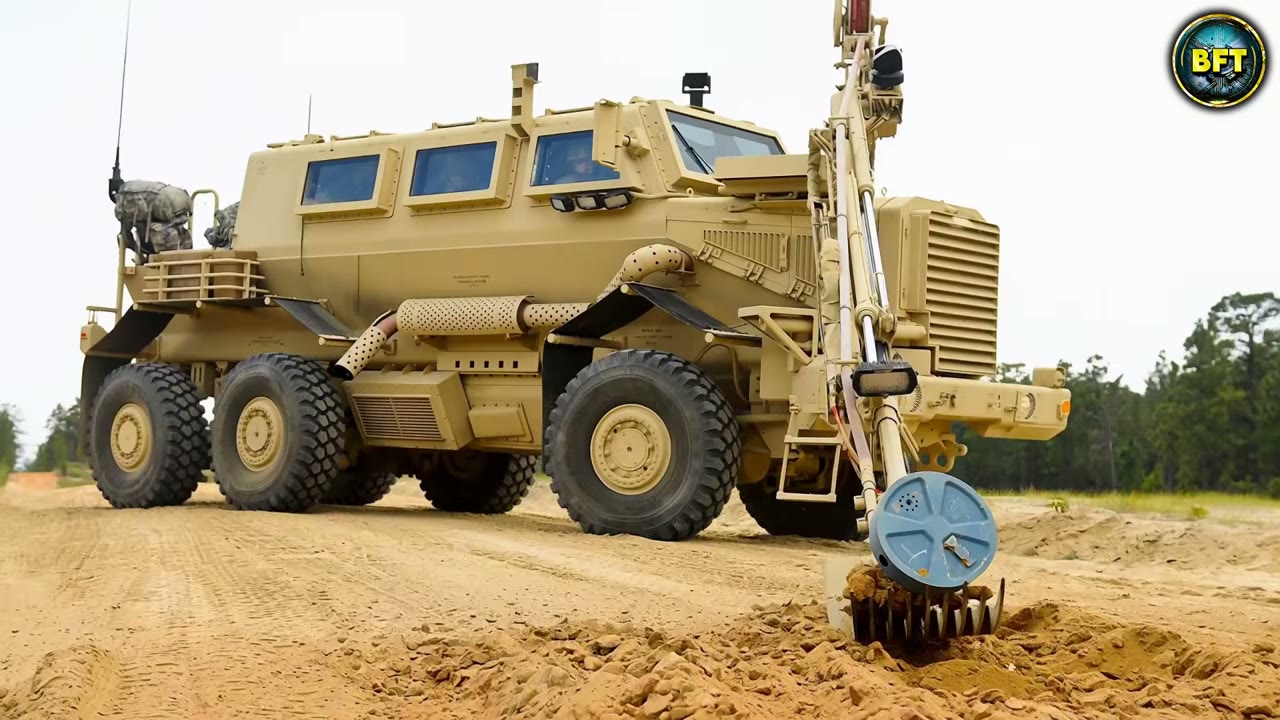
1Buffalo MPCV leads list at number 10 with robotic arm and V-hull
A 20-ton armored truck carries a 9-meter robotic arm built to defuse roadside bombs. The Buffalo MPCV, ranked tenth on this list, was designed to clear roads of deadly explosive devices so infantry can move without fear of hidden traps.
The vehicle weighs over 20,500 kg and stands almost 4 meters tall. Its crew sits safely inside, operating the camera-equipped "Iron Claw" to excavate, explore, and inspect suspicious objects on the ground.
Underneath the steel, a curved V-shaped hull redirects the explosive force of mines outward, away from the six crew members inside. A diesel engine pushes the truck to speeds of up to 105 km/h in open terrain.
2AAVP7A1 amphibious assault vehicle takes number nine
A 29,000 kg steel vehicle swims through the ocean and then carries 21 Marines onto a sandy shore. The AAVP7A1, number nine on this list, was built for the US Marine Corps to dominate both sea and land.
Powerful water cannons propel it through the water at up to 13 km/h. Once it reaches shore, its tracks bite into the soil and accelerate it over land to 72 km/h.
Inside its armored hull, it carries up to 21 fully equipped Marines plus a crew of three. A gun turret with a 40 mm automatic grenade launcher and a 12.7 mm heavy machine gun lets it suppress enemy positions before troops step out from the stern ramp.
3Bison APC ranks eighth for modular eight-wheeled flexibility
One armored vehicle can be reconfigured as a command post, a mobile workshop, an armored medical vehicle, or a troop transport. The Bison APC, ranked eighth, prioritizes speed, maneuverability, and eight large wheels.
The light armored vehicle weighs around 13,000 kg and reaches speeds of up to 100 km/h, keeping pace with other equipment on paved roads or rough terrain.
A crew of two operates it, carrying up to six fully equipped soldiers. Specialized steel armor protects against small arms fire and artillery shell fragments, and smoke grenade launchers create an instant curtain during shelling. It usually carries a 7.62 mm or 12.7 mm machine gun on the roof.
4M3A3 Bradley takes seventh with hunter-killer targeting and TOW missiles
A scout vehicle can spot targets in complete darkness and destroy tanks from over 3,700 meters. The M3A3 Bradley, number seven on this list, is an armored cavalry fighting vehicle designed for reconnaissance ahead of the main force.
Weighing over 30,000 kg, it reaches 61 km/h on rough terrain. An independent commander's thermal imaging device lets it search for targets in darkness or smoke while the gunner engages an already found target — a "hunter-killer" ability.
Its 25mm Bushmaster automatic cannon destroys light armor, and a twin 7.62mm machine gun adds firepower. A dual launcher for TOW anti-tank guided missiles can destroy equipment from over 3,700 meters. Digital battle management systems share real-time map data with allied units, and advanced dynamic armor explodes outward to neutralize projectiles.
5LAV-25A2 ranks sixth as amphibious Marine reconnaissance vehicle
An eight-wheeled scout swims rivers at 10 km/h and races along tracks at 100 km/h. The LAV-25A2, number six on this list, is an aggressive reconnaissance vehicle for the US Marine Corps.
Weighing about 12,800 kg, it is fully amphibious and crosses water obstacles using special stern propellers, so it can scout far ahead of main forces without waiting for engineers to build a bridge.
The A2 modernization improved armor, thermal imaging targeting systems, and automatic fire suppression. Its primary weapon is a 25mm Bushmaster automatic cannon firing armor-piercing rounds, backed by two 7.62mm machine guns. A crew of three drives it while six Marine reconnaissance officers sit in the back. Its low weight allows rapid transport by aircraft.
6M1126 Stryker enters top five as networked rapid response vehicle
Every eight-wheeled Stryker carries a digital battlefield map showing the location of friendly units and enemy forces. The M1126 Stryker, fifth on this list, was designed to fill the niche between heavy tracked tanks and light trucks as the US Army's rapid response vehicle.
Weighing approximately 19,000 kg, it reaches 97 km/h with a range of over 500 km on a single tank of fuel, so an entire Stryker brigade can cover hundreds of kilometers in a day.
The M1126 serves as an armored personnel carrier, transporting two crew members and up to nine armed infantrymen. A remotely controlled combat module lets the gunner fire a 12.7 mm machine gun or a 40 mm grenade launcher by joystick while staying inside the hull. Lattice armor resembling a steel cage can be fitted against grenade launchers, and puncture-resistant tires with a central inflation system keep it moving under fire.
7M142 HIMARS takes fourth with GPS precision strikes up to 300 km
Guided rockets fired from a truck can hit targets up to 80 km away with an accuracy of one meter. The M142 HIMARS, fourth on this list, is mounted on a maneuverable 5-ton 6x6 truck chassis and has radically changed modern artillery warfare.
Weighing around 16,200 kg, it travels at up to 85 km/h on roads and can be loaded onto a military transport plane to land anywhere in the world.
It carries a launch pod for six guided missiles or one massive tactical ballistic missile. With an ATACMS missile, the range increases to 300 km. The strategy is simple: shoot and go — approach a position, release the entire ammunition load in seconds, and leave before enemy radars track where the missiles came from.
8M270A1 MLRS ranks third with double rocket pods on tracked chassis
Twelve high-precision GPS-guided missiles can launch in less than 60 seconds from a single tracked launcher. The M270A1 MLRS, third on this list, is the heavyweight older brother of HIMARS.
While HIMARS relies on six wheels, the M270A1 uses heavy tracks based on the Bradley infantry fighting vehicle chassis to break through mud or snow. It weighs a massive 25,000 kg and reaches 64 km/h.
Military commanders call it a "square racer" because it carries two launch pods — double the HIMARS load — for 12 GPS-guided missiles or two long-range tactical missiles. The A1 upgrade added a fully armored cockpit protecting three crew members from small arms fire, shell fragments, and chemical threats, plus a modern fire control system that speeds up targeting and firing.
9M109A7 Paladin is second with 155mm gun and Excalibur rounds
A 155mm artillery shell can land on a concrete roof from over 30 km away. The M109A7 Paladin, second on this list, is a self-propelled howitzer built to move with advancing infantry and tanks and fire high-explosive shells on demand.
Weighing 35,000 kg, it shares the engine, transmission, and track components of the Bradley Fighting Vehicle, traveling over rough terrain at up to 61 km/h.
An automatic homing and digital fire control system lets it acquire target coordinates, stop, aim, and fire the first shell within seconds of receiving an order. Standard shells hit targets beyond 21 km; high-precision rounds such as Excalibur extend the range past 30 km. A crew of four works inside an armored cabin with climate control and a 600-volt electrical system.
10M1A2 SEPv3 Abrams tops list with Trophy active protection system
A 66.8-ton tank can now swat incoming anti-tank missiles out of the air by itself. The M1A2 SEPv3 Abrams, fitted with the Trophy active protection system, tops a ranking of the most modern equipment in the US Army.
The Trophy system uses radar to detect enemy anti-tank missiles in flight and automatically shoots them down before they touch the tank, according to the account. The SEPv3 is the newest and most advanced upgrade package ever installed on an Abrams.
Its 1,500-horsepower gas turbine engine, which the account says roars like a jet, pushes the 66,800 kg vehicle to 68 km/h. The main weapon is a 120mm smoothbore gun that can fire smart munitions programmed to detonate in mid-air, delay penetration or destroy thick enemy armor.
Upgraded composite armor uses depleted uranium. Inside, a crew of four works in a fully digital cockpit with thermal sights that see through darkness, smoke and dust storms. An auxiliary power plant runs the combat systems without starting the main engine.