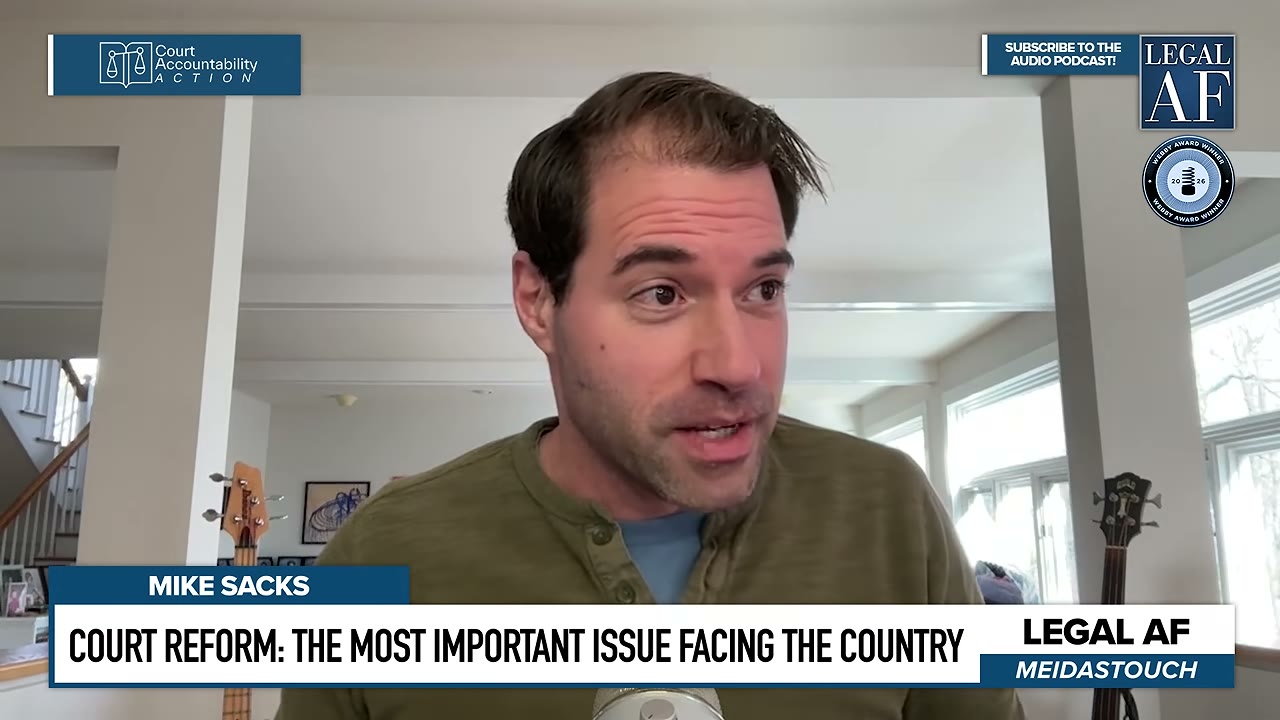
Justice Samuel Alito told the Federalist Society that "bad guys" want to defund the Supreme Court through Congress. This round-up covers the push for ethics oversight, jurisdiction limits and term limits as Democrats weigh how to counter the court.
1Democrats face structural limits despite 2026 midterm hopes
Democrats could win a large pro-Democratic majority in the 120th Congress and still be unable to move their agenda forward. They will not have the president, and possibly not the Senate, because of the filibuster, according to the analysis.
That does not mean they should not try, the argument goes. The real confrontation still needs to happen.
Writing in the lead article of the December issue of The Nation, justice correspondent Ellie Mistal says there is one issue that drives all others.
2Ellie Mistal argues Supreme Court reform is the issue that drives all others
Even if the filibuster is abolished, partisan gerrymandering ends and a president signs Democratic bills, one body stands ready to stop it all, according to justice correspondent Ellie Mistal. That body is the Supreme Court.
Democrats control only the legislative branch, she said. They do not control the executive or the judicial branch.
"The judicial branch was created to stop the will of the people," Mistal said, pointing to wins in Texas and Mississippi. She argued that unless Democrats meet the challenge head-on and try to limit the power of the Republican-controlled Supreme Court, "nothing else matters."
3Alito warns Federalist Society that Democrats may defund the Supreme Court
Justice Samuel Alito told the Federalist Society that "bad guys" want revenge by defunding the Supreme Court through Congress. Lawmakers would tighten the court's purse strings, he said, so it could no longer impose its will on everyone else.
The guest's reaction was delight. The idea to defund the court was hers, she said.
Hearing Alito describe it as a threat "just made my heart sing," she said, because that is exactly what Democrats should do.
4Guest urges Congress to use budget power to force Supreme Court ethics oversight
Congress should use its control over the Supreme Court's budget to pressure the justices until they accept independent ethical oversight, the guest argued. She called it "the key to everything 100%."
She drew a line: she does not think Democrats should use the court's money to change its decisions. But withholding funds until justices stop taking bribes is "just smart," she said.
The Supreme Court has ruled that Congress cannot regulate it, she said, though the Constitution gives Congress power to set rules for the court. She pointed to Amy Coney Barrett and Elena Kagan asking Congress for more money and security, and said she would not grant it until the justices agree to an ethics law and third-party oversight.
5Guests debate applying a mandatory ethics code to all nine justices
Supreme Court justices should face the same mandatory ethics standards as every other federal judge, the guest said. But ethics alone will not reform the judiciary.
She called it "a necessary but insufficient component" of any reform package. Much of the ethics debate centers on Samuel Alito and Clarence Thomas, who may try to hold out another six years.
She said the only incorruptible justice, in her view, is Elena Kagan, recalling how Kagan refused to let her buy her a pack of cigarettes at Harvard Law School. Others were exposed only because ProPublica investigated, and ProPublica cannot subpoena, she said. She hopes the Senate and House Judiciary Committees investigate all nine justices.
6Guest says Supreme Court's power to decide constitutionality is fabricated
The word "unconstitutional" appears nowhere in the Constitution, the guest said. The Supreme Court's power to decide what is constitutional was assumed in 1803 in Marbury v. Madison.
Asked whether the court should have that power, she answered: "Absolutely not."
She said the idea that only one branch can decide constitutionality is "completely fabricated" — something the court "pulled literally out of thin air." In her account, it was a seizure of power in 1803 that everyone simply accepted.
7Congress could strip Supreme Court jurisdiction over campaign finance appeals
Congress can limit what the Supreme Court hears on appeal, the guest argued, through its constitutional authority over the court's jurisdiction. The Constitution gives the court original jurisdiction in suits between states; everything else comes on appeal.
She floated a test: Congress could bar the court from hearing appeals of its campaign finance laws, then pass reform. She pointed to a new Montana law barring corporate entities from spending money in politics, which Republicans challenged before the election was over.
Congress could have limited jurisdiction by declaring the court prohibited from ruling on state campaign finance laws, she said. She urged this Congress to try it and "set the stage" for 2029.
8Guest floats court expansion with judges ready to overturn Roberts precedents
The tougher option is filling the court with judges ready to overturn the Roberts Court's anti-democratic decisions, the guest said. She does not think it takes "radical liberals" — just judges who understand the role of Congress.
She said Democrats need appointees with "fire in their hearts" and the determination to overturn bad precedents. Not every judge, even ones she agrees with, would go through with it.
She compared it to Republicans, who sought out judges like Thomas, Alito and Neil Gorsuch eager to undo the 20th century. "We on the left wing need to find judges who are ready to abolish the 21st century," she said.
9Biden's lower court judicial appointments praised as underappreciated
Biden's record appointing judges to the lower courts is under-reported and under-appreciated, the guest said. Many reflect a different vision of the bench.
Yes, he appointed many Harvard and Yale graduates and many former prosecutors, she said. But he also appointed many public defenders and many people with ethnic, gender, racial and orientation diversity.
She said those judges understand the task and are not there to rubber-stamp the decisions of the Trump administration and the Roberts court.
10Sheldon Whitehouse replacing Durbin to lead Senate Judiciary Committee
Senate Judiciary Committee leadership is shifting from Dick Durbin to Sheldon Whitehouse, a change the guest called one of the huge outcomes of the election. The committee confirms judges.
She called Durbin "one of the worst and weakest people" Democrats could have had as chairman.
Whitehouse, by contrast, at least understands the deep corruption in the judicial system through the Federalist Society and is prepared to confront it, she said.
11Guest urges Democrats to block all Trump judicial nominees after January 3
Democrats should confirm zero Trump judicial nominees for the next two years, the guest argued in an unpublished piece. Not to the Supreme Court, not to the Courts of Appeals, not to the District Courts.
"Trump should get nothing," she said. She has not gotten the White House to commit to the strategy.
She described a wave of Trump judges who cannot say who won the 2020 election or whether Brown v. Board of Education was right. That stops, she said, on January 3rd.
12Republicans rush to confirm 25 Trump judges during lame duck
Republicans are racing to confirm as many federal judges as possible during the lame duck period. Trump has requested confirmation of 25 judges, and the Senate had already expedited consideration of three of them as of the recording.
Republicans will try to fill every seat available, and there is little Democrats can do to stop it, the guest said. After January 3rd, it all stops for two years.
Presidents push judges through because "it is through the judges that politics survives the presidency," she said. Trump's judges, she added, will be fought for the next 20 or 30 years.
13Guest calls for expanding lower courts, long overdue since 1991
The lower courts have not been expanded since 1991, under the first Bush administration, the guest said. She called a massive expansion long overdue.
The country used to expand the courts every 20 to 25 years as a matter of course, she said. There are more people and more lawsuits now.
She pointed to arguments to split the Ninth Circuit, the largest in the country, covering states including California, Washington, Oregon, Alaska, Hawaii, Idaho, Arizona, Nevada and Montana. Senator Mike Crapo of Idaho wants a conservative new district, she said, but setting partisanship aside, the Judicial Conference has repeatedly pleaded for more district judges.
14Partisan standoff blocks bills to expand the judiciary
Neither party wants more federal judges when the other side controls the White House and Senate. Democrats resist expansion under a Republican triumvirate; Republicans resist it under a Democratic one, the divide running at least between the White House and the Senate.
Bills have been introduced in this Congress to expand the judicial system simply to meet capacity needs and take partisanship out of it — a sign of good governance, one guest argued. With Democrats in charge of Congress, the guest called it a unique opportunity and said he would probably write about it in his next column.
15Guest proposes expanding courts under Trump with bipartisan commission
A guest floated a deal: expand the lower courts under Trump, then hand the picks to a bipartisan commission. He acknowledged the tension himself — earlier he had said Trump shouldn't get any new judges.
"I'm playing both sides a little bit here," he said. Under his proposal, a bill would add 30, 40 or 50 judges, with Trump, Congress and an evenly split commission choosing them. He called it a lab experiment worth trying now.
16Debate over what partisanship means for judicial picks
A guest argued partisanship over courts now cuts two ways: one side seeks anti-democratic consolidation, the other says let the people decide. He noted Trump won the popular vote despite everything else, and said people are rejecting what followed.
He said he could be convinced to back Republican judges — with evidence. He'd need a list of judges who support democracy, recognize the power of the people and agree the people, not judges, have the final say. He cited Ed Meese's 1980s push for judicial restraint, and said he has no interest in more Trump-style judges holding the political pendulum hostage.
17Guest sets standards for acceptable Republican judges
Compromise is not simply doing what Republicans want, a guest argued. He said Democrats swing between getting their way and complete capitulation to Trump's agenda — neither is a real compromise.
He set standards for acceptable Republican judges: pro-democratic, anti-racist, basic decency. An originalist who still agrees women are people is someone he can talk to, he said; one holding the literal 18th-century view that women are closer to children or dogs is not. He said he must win the battle for democracy and humanity for every single judge.
18Term limits for Supreme Court justices debated as reform option
An 18-year term limit would remove John Roberts, Samuel Alito and Clarence Thomas, who have served more than 18 years as of this writing. A guest still called term limits a waste of political capital.
Lifetime appointments are bad, he said, but the Constitution requires them under most interpretations, including at least five justices'. Law professors argue term limits need no amendment, but the people deciding constitutionality sit on the court already. Term limits won't restore abortion rights, reinstate affirmative action or overturn Citizens United, he said. "They don't fix anything."
19Critic compares term limits to asbestos in a burning building
Term limits are like adding asbestos to a building that's already on fire, a guest said. The structure can be improved later; right now the fire needs water.
He stressed he has nothing against term limits — they simply don't help in the moment. Structural fixes to prevent the next fire can be discussed after this one is put out, he said, but first the fire has to go out.
20Court's right-wing agenda will outlast Trump, guest warns Congress
The fire will rage whether or not Trump is in office, a guest warned. The court was formed before Trump appeared, in the imagination of those who sought to capture it, he said.
Trump was a tool to implement the right-wing movement's ideological, political and strategic agenda, he argued — and that agenda will remain when he is gone. His closing message to Congress: start thinking.