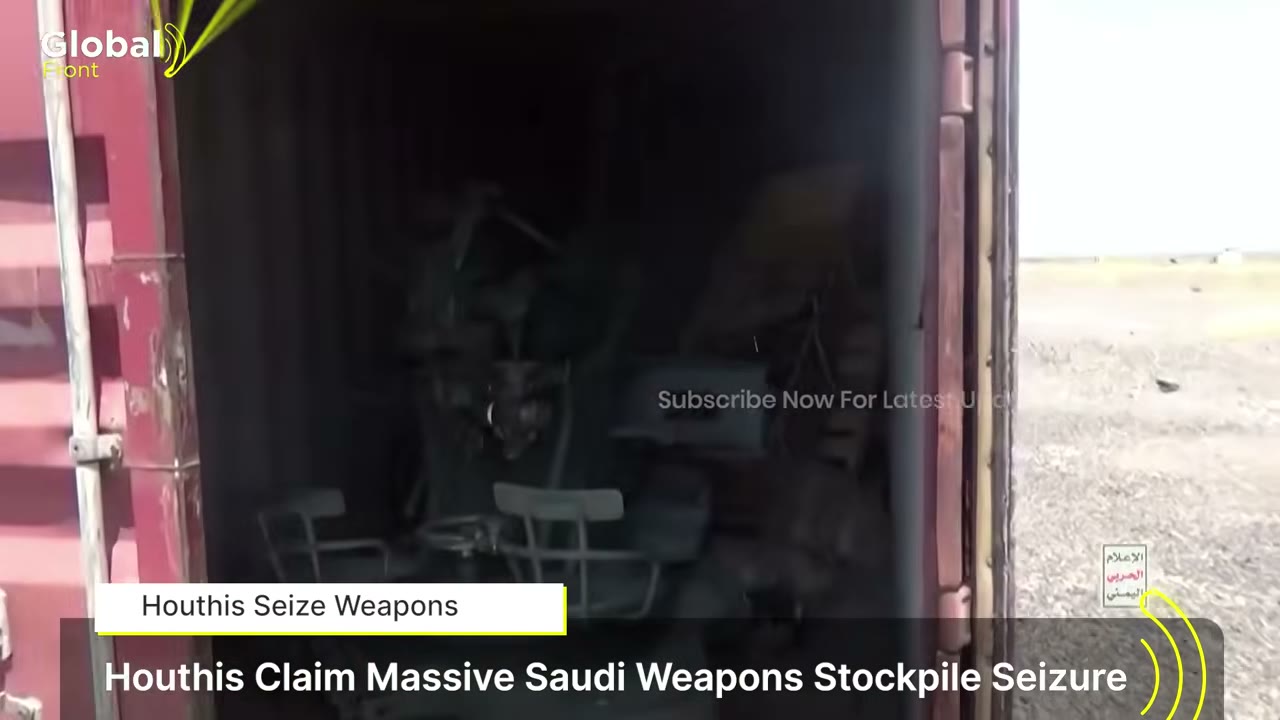
Footage released by the Houthis shows warehouses of weapons, ammunition and vehicles allegedly seized from Saudi-backed forces in Yemen. The group claims the haul is its largest ever, but locations, quantities and origins remain unverified.
1Houthis Show Footage of Weapons Allegedly Seized from Saudi-Backed Camps
Footage has emerged showing vast quantities of weapons, ammunition, military vehicles and heavy equipment allegedly captured from camps linked to Saudi-backed forces in Yemen.
The images show rows of storage containers, warehouses filled with military equipment, and vehicles carrying equipment that the armed group controlling the sites claims was abandoned during a retreat.
The video is accompanied by a statement that Yemeni forces no longer need to rely entirely on weapons imports, as they can manufacture equipment in-house or obtain additional supplies from captured military positions.
The footage attempts to demonstrate not only the scale of the claimed captures but also the potential implications for Saudi-backed forces and the broader military balance in Yemen.
2Background on Yemen's Conflict and Houthi Control
The Houthis, formerly known as Ansar Allah, control Yemen's capital Sanaa and much of the north, while the internationally recognized government remains separate from their administration.
The reported weapons seizures take place against the backdrop of a protracted conflict involving the Houthis, the internationally recognized government, Saudi Arabia and several other regional players.
The distinction matters: statements by the armed group do not represent Yemen as a whole. According to the narrator, military supplies can either be produced locally or obtained from camps previously occupied by opposing forces.
3Warehouse Tour Reveals Ammunition and Artillery Supplies
Open metal containers packed with ammunition sit beside sealed ones in footage that the narrator describes as showing enough supplies to support military operations for many years.
The camera moves through an area holding large metal containers, ammunition, military transport equipment and what appears to be artillery equipment. Several containers are open, revealing packages stacked inside.
The narrator's estimate has not been independently verified. One of the most notable scenes shows personnel moving large numbers of ammunition crates; the narrator first speaks of dozens or hundreds of boxes before suggesting the actual number could be in the thousands.
The material includes ammunition described as intended for artillery installations, along with other supplies whose precise characteristics cannot be reliably determined from the images.
4Military Logistics Value of Captured Equipment
The captured equipment includes the very vehicles used to move, guard and collect military supplies, according to the narrator, extending the seizures beyond weapons to logistics.
Ammunition reserves, storage facilities and transportation systems are key components of military logistics. Forces that acquire large quantities of usable equipment can reduce some immediate resupply needs, though the actual benefit depends on compatibility, condition, maintenance and operational needs.
Heavy vehicles can be particularly important for moving equipment between storage locations and operations areas. Refuelers and other military equipment also appear in the footage.
5Warehouse Described as Only Fraction of Larger Facility
The warehouse shown on camera is described as just one part of a much larger military facility, with similar storage areas said to lie elsewhere in the camp.
Inside, metal crates, storage racks and military supplies take up a significant portion of the visible space. The narrator repeatedly emphasizes that the filmed warehouse is only a fraction of what was reportedly seized.
In a statement translated into English, the supplies are described as the largest quantity of weapons and ammunition ever captured by the group's fighters — a significant development if independently confirmed. Without a verified inventory or comparison to previous seizures, the claim remains unfounded.
Still, the footage shows why the group presents the operation as a significant achievement.
6Symbolic Value and Uncertain Circumstances of the Seizure
Much of the footage focuses on equipment left behind after opposing forces reportedly retreated, not on prolonged fighting around the warehouses.
That distinction matters: the circumstances under which the supplies changed hands remain unclear. The materials do not establish whether the objects were abandoned during a rapid retreat, captured as a result of fighting, or transferred under other circumstances.
It has also not been independently established which military formations controlled each facility before the reported capture.
Images of captured supplies can be used to demonstrate military momentum, undermine adversaries' confidence and reinforce claims of increased operational capabilities.
7Camp Linked to Giants Brigade and Missiles Left Behind
At one point the speaker identifies a camp associated with the 3rd Giants Brigade, a formation within the broader Giants or Amalika Brigade that fought against the Houthis in Yemen.
The footage includes references to missiles allegedly left at the location, with the speaker noting that some of the equipment will later be destroyed. The exact circumstances of this claim are unclear, and the images do not show what happened to the items afterward.
The Giants Brigades were one of the most prominent military formations opposing the Houthis. Their operations are linked to a complex network of pro-government southern and other anti-Houthi forces, and individual units may operate under different command arrangements.
8Inspecting Supplies: RPG Ammunition and Drone Components
Personnel inspecting the stockpiles identify some equipment as RPG ammunition and other items as components for drones, according to speakers at the scene.
Identifying a camp by brigade name does not in itself establish direct Saudi involvement in every item found there.
The exact models, manufacturers and purposes of the items have not been independently confirmed. Even so, the presence of varied equipment is a characteristic feature of the images.
9Celebratory Tone but Doubts Over Usability of Captured Gear
Staff are seen expressing satisfaction and gratitude as they inspect the supplies, reflecting the celebratory tone of footage that presents the capture as a major military success.
The broader implications remain uncertain. Captured equipment is not necessarily immediately usable: ammunition may require inspection, vehicles may require maintenance, and specialized systems may depend on technical support or complex platforms.
The number of visible containers also does not allow determination of how many serviceable weapons are inside them.
The scenes show an assortment of ammunition crates, vehicle components, storage containers and military transportation systems.
10Equipment Reportedly Moved Before Filming Began
Some of the equipment was removed before filming even began, according to the narrator, who claims fighters moved even larger amounts of supplies and military equipment to safe locations.
No independent documentation has been provided to confirm the volumes or destinations.
The camera continues to move through areas with dozens of large metal crates described as filled with ammunition and weapons. The constant emphasis on storage capacity and supply volumes is intended to demonstrate the scale of the alleged losses inflicted on enemy forces.
These limitations matter when evaluating claims that the stockpiles could sustain military operations for several years.
11Self-Sufficiency Claim vs UN Findings on Houthi Weapons
UN experts have documented that the Houthis are expanding domestic production and assembly capabilities while continuing efforts to obtain weapons, components and dual-use materials through external supply chains.
That finding complicates the group's message that external military pressure has not stopped it from maintaining access to weapons. Displaying captured arms does not prove complete military self-sufficiency.
The origins of Houthi weapons have long been under international investigation, including questions about domestic production, imported components, illicit supply chains and equipment captured during the conflict.
Independent assessments suggest local production and foreign procurement can operate together.
12Alleged Saudi-Supplied Trucks, License Plates and Documents
Trucks seized in Yemen carry Saudi license plates, and the drivers' documents reportedly list them as Saudi residents, according to a Houthi video that presents the vehicles as proof of Saudi-supplied military aid.
The video describes cargo including small arms, ammunition, artillery systems, protective gear and advanced optical devices. It says some loads held longer-range artillery equipment and guided systems.
No independent technical assessment backs those descriptions, and the announcer offers no evidence for a claim that the equipment is only a fraction of what could be shown publicly.
Shipping documentation allegedly links some of the equipment to Saudi supply chains. The announcer says the plates and papers show Saudi involvement in backing forces fighting the Houthis.
Saudi Arabia has supported Yemen's internationally recognized government and allied forces through much of the conflict. Plates or residency papers alone cannot prove who owns each item or where it was headed.