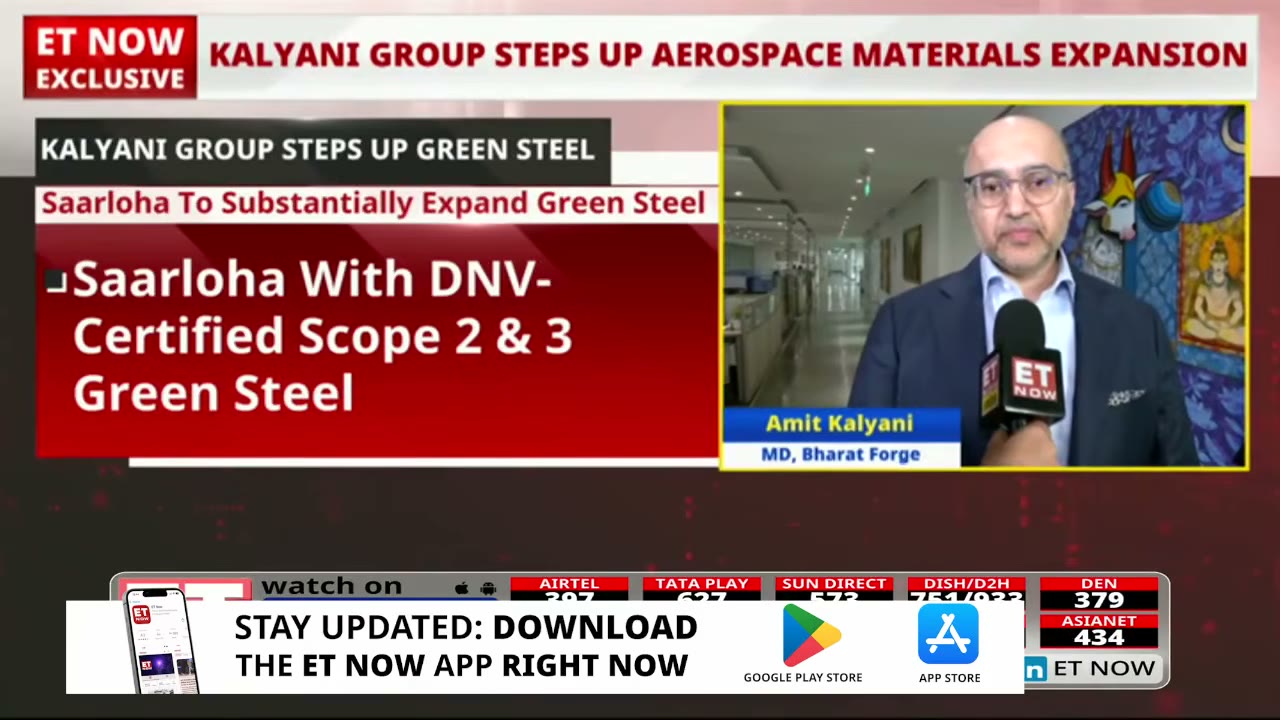
Kalyani Group's Amit Kalyani says Sarloha became the first steel company worldwide to get third-party certification for green steel under scopes two and three, and is expanding capacity. He also outlines a new aerospace materials plant and calls for a long-term policy vision on cheap imports, tariffs and supply-chain self-reliance.
1Sarloha Becomes First Steel Company Certified for Green Steel Under Scopes 2 and 3
Sarloha has become the first steel company in the world to win third-party certification for green steel under scopes two and three, according to Amit Kalyani. The audit came from DNV, the certification body.
Kalyani said the company already produces and ships green steel and products around the world. It now plans a significant increase in green steel production capacity in the near future.
The claim rests on scopes two and three, which cover emissions beyond a company's own operations. "We already produce and ship green steel and products around the world," Kalyani said.
What comes next is scale: the company says capacity will rise substantially, though it gave no figure or timeline.
2Kalyani Group Builds New Plant to Expand Aerospace Materials Portfolio
A new plant is coming to expand the Kalyani Group's aerospace materials portfolio, Amit Kalyani said. It will sit at a different location and make both raw materials and finished materials and products for the aerospace sector.
The move extends the group beyond steel. Kalyani described it as a significant expansion of the aerospace materials business.
He did not name the location, the investment or a timeline. The plant's output is meant to cover the full chain, from raw materials to products for aerospace use.
It follows the company's stated plan to raise green steel capacity, with aerospace now a second growth front.
3Amit Kalyani Urges Long-Term Policy Vision Against Cheap Imports and Tariffs
Cheap imports and trade tariffs have become a threat to steel producers, and Amit Kalyani wants a long-term plan to deal with them. Asked what policy support he expects as the budget approaches, he called for a lasting vision to support industries and keep them competitive.
He did not list specific measures or demands. His answer focused on the frame: support that holds over time rather than a short-term fix.
"We need to form a long-term vision of how to support industries and maintain their competitiveness," he said.
The budget is the next test of whether that vision appears.
4Kalyani Warns India Must Build EV and Magnet Capabilities Fast
Electric cars are already on sale in India, but many of the materials and components inside them are imported. Amit Kalyani says the country must build its own capabilities very quickly.
An incentive scheme, the PLI, is already being implemented for magnets and other materials needed for electric vehicles, he said.
The gap is local supply. Components come from abroad while the policy push aims to shift production home.
Kalyani's warning sets a clock: the scheme exists, but the capability does not yet match the market.
5Kalyani Says India Cannot Fall Behind in Aerospace, Defence and New Energy Materials
Falling behind in aerospace, defence or new energy materials means depending on someone else for supply chains, Amit Kalyani warned. India, he said, has to be one step ahead.
His argument is about leverage: once a country lags, it loses control over where critical materials come from.
"We can't fall behind, because if you fall behind, you become dependent on someone else for supply chain issues," he said.
The comment ties the group's aerospace expansion and the EV materials push to a single concern: self-reliance in strategic materials.