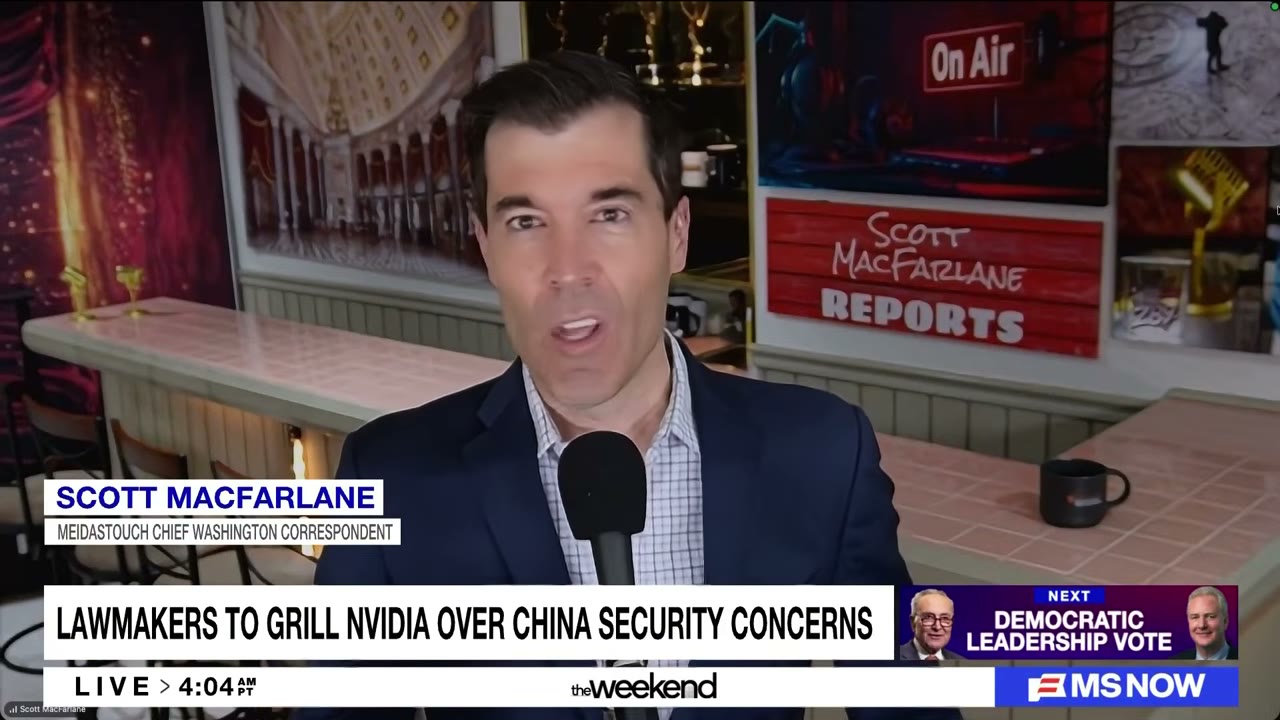
A journalist panel discusses President Trump's demand that 'superintelligence' replace 'artificial intelligence' as a mandatory term, raising freedom of speech questions. They also preview Nvidia CEO Jensen Huang's three days of Capitol Hill testimony on chip smuggling to China and DOJ staffing losses.
1Jensen Huang's closed-door and public testimony on Nvidia chip smuggling to China
Nvidia CEO Jensen Huang faces three days of sworn questioning on Capitol Hill, including closed-door transcribed interviews Tuesday and Wednesday and a public Senate banking committee hearing Thursday. Lawmakers are concerned about what they call the mass smuggling of chips to China, potentially to the Chinese military. Republicans and Democrats will alternate questions in the private sessions. "These things do not stay behind closed doors," a journalist said, predicting readouts will leak. Senator Elizabeth Warren is expected to lead Democratic questioning at Thursday's public hearing. Huang is under oath throughout.
2New York Times editorial urges Democrats to halt Trump corruption via funding bills
The New York Times editorial board wants Democrats to refuse basic government funding bills until the Trump administration adheres to the law. In a piece this week, the board argued the most urgent priority is halting ongoing abuses and preventing more, saying rampant corruption should no longer get a free pass. On Capitol Hill, there is appetite among Democrats to discuss the idea, but it remains contentious. A similar fight over using funding bills to force a debate on Iran is already dividing the party, with the left pushing the tactic and the establishment resisting.
3Democrats weigh using government funding fights for oversight of Trump
Senator Cory Booker says Democrats must be able to hold the administration accountable and keep funding the government at the same time. Speaking recently in South Carolina, Booker said, "shutdowns and not funding things hurts people." His comments come as some in his party weigh refusing to debate funding bills when subpoenas go unanswered — an approach one journalist called even more questionable than tying funding to oversight demands. Booker's stance suggests resistance within Democratic ranks to using shutdown threats as a leverage tool.
4Trump calls for 'superintelligence' to be made mandatory term, raising free speech concerns
President Trump asked the SEC chairman to make the term "superintelligence" mandatory, calling it a matter of accuracy in language. In a social media post, Trump said Fox News host Shannon Bream keeps saying "artificial intelligence" and asked that someone explain the correct term to her, adding that SEC Chairman Paul Atkins "will soon be making that term mandatory." A journalist called it one of the strangest things to happen recently, arguing the president is flirting with a free speech violation by demanding Americans use a word he prefers. Trump, the journalist said, doesn't seem to care that the label doesn't change anything.
5Courts and agencies push back on Trump's pressure campaigns against media
A court ruled the Federal Communications Commission could not launch its investigation of ABC television and its affiliate stations, a setback for the president's pressure campaign against media outlets. The probe was tied to what Trump called ABC's diversity hiring program, but ABC believed it was a crackdown over speech on Jimmy Kimmel and The View. The ruling came just as Thanksgiving began. The unorthodox use of federal agencies to inflict pain on media organizations and private businesses has been floundering in recent weeks, and one journalist said there is "absolutely nothing beneath" the president's threats.
6Trump's past free speech promises contrast with new language mandate
On January 20, 2025, President Trump promised to "immediately stop all government censorship and bring back free speech to America." Now he is asking the SEC chairman to make the term "superintelligence" mandatory — a demand a journalist called completely different from that pledge. The contrast feels foundational, especially after Republicans and right-wing media spent years warning of a war on words. What's alarming, the journalist said, is that even Trump's allies aren't listening to the new demand. The president has a long history of going back on promises, the journalist added.
7Even Trump-allied podcast abandons 'superintelligence' term after a week
All In, described as the number one Trump-supporting podcast, used the term "superintelligence" for about one week before returning to "artificial intelligence." The reversal suggests even the president's allies aren't following his new language demand. A journalist said that when your own allies aren't listening, it's time to wonder what the president is trying to do. The journalist's take: Trump is a man who always calls his treasury secretary "central casting," decided he likes this phrase, and is now flirting with a free speech violation just because he's so into it.
8Justice Department relies on shrinking pool of lawyers for high-profile cases
The Justice Department is relying on a shrinking number of lawyers to bring its most high-profile and controversial cases, the Washington Post reported. That marks a sharp change from previous administrations, when political appointees rarely entered courtrooms and left litigating — even in fraught cases — to career prosecutors. Democrats face a whack-a-mole problem as investigations pile up, including the promised campaign-trail probes. Lawmakers are concerned about the turnover inside the department as they try to sort out the hierarchy of investigations.
9House Judiciary chairman says Nvidia now a priority amid shifting investigations
The incoming chairman of the House Judiciary Committee told a reporter that Nvidia wasn't on his radar a few weeks ago — now it very much is. He declined to name his first priority, saying something new lands on the table every couple of weeks that he has to triage. That is the nature of investigating Trump 2.0, the chairman said. Lawmakers are also concerned about turnover at the Department of Justice as they balance competing probes and the media attention Nvidia is absorbing.
10DOJ loses one-third of lawyers and 20,000 employees, some join congressional probes
One-third of the lawyers inside the Justice Department are gone, according to new reporting covering January 2025 through November 2026. The agency has lost more than 20,000 employees, including that many attorneys — a staffing crisis inside America's top law enforcement agency. Some of those who quit under protest or were purged are now joining congressional committees as staffers, helping investigate the department they left. The revolving door puts former DOJ lawyers on the other side of the oversight fight.
11Democrats plan to target private businesses to bypass executive privilege
Democrats don't expect the Trump administration to comply with any subpoenas, so they are planning to target private businesses instead. With gavels on both sides of the Capitol, they are looking for tools they may never have used before, including companies that lack the executive privilege shield Trump is expected to invoke. If Donald Trump Jr. engaged in a questionable potential deal with a crypto company, Democrats would go to the crypto company first — it is more likely to respond and less likely to fight over executive privilege.
12Trump claims Jensen Huang is no security threat based on 'information and belief'
Donald Trump says Jensen Huang is "absolutely fine" as a security matter — and when pressed for evidence, he cited only "information and belief." The president was asked how he could be sure Huang is not a security threat when the Justice Department says there has been no proper investigation.
"Based on information and belief, I think he's absolutely fine," Trump said. Asked what information that was, he replied: "The information I have, which is a lot of information."
Trump said Huang is happy to be going back and calls it his second term. Trump said he did "a great thing for our country and even for the world."
The exchange drew a pointed contrast: Trump can tell the American people things without giving them any information, the journalist noted, but Huang cannot.
13Bipartisan hope for tough questioning of Jensen Huang over China export controls
Lawmakers from both parties want to constrain the ability to send chips to China — and that bipartisan push could make Thursday's hearing harder for Jensen Huang than the usual congressional spectacle.
One journalist said there is "some glimmer of hope" for real questioning, pointing to bipartisan concern and a post-election mood with less political peacocking. "It's going to be a marathon but there will be some hard questions," the journalist said.
Another agreed, citing the fight over export controls and lawmakers from John Thune on down who, the journalist said, are ready to act. The exception may be Senator Warren, who "does like to make a point."