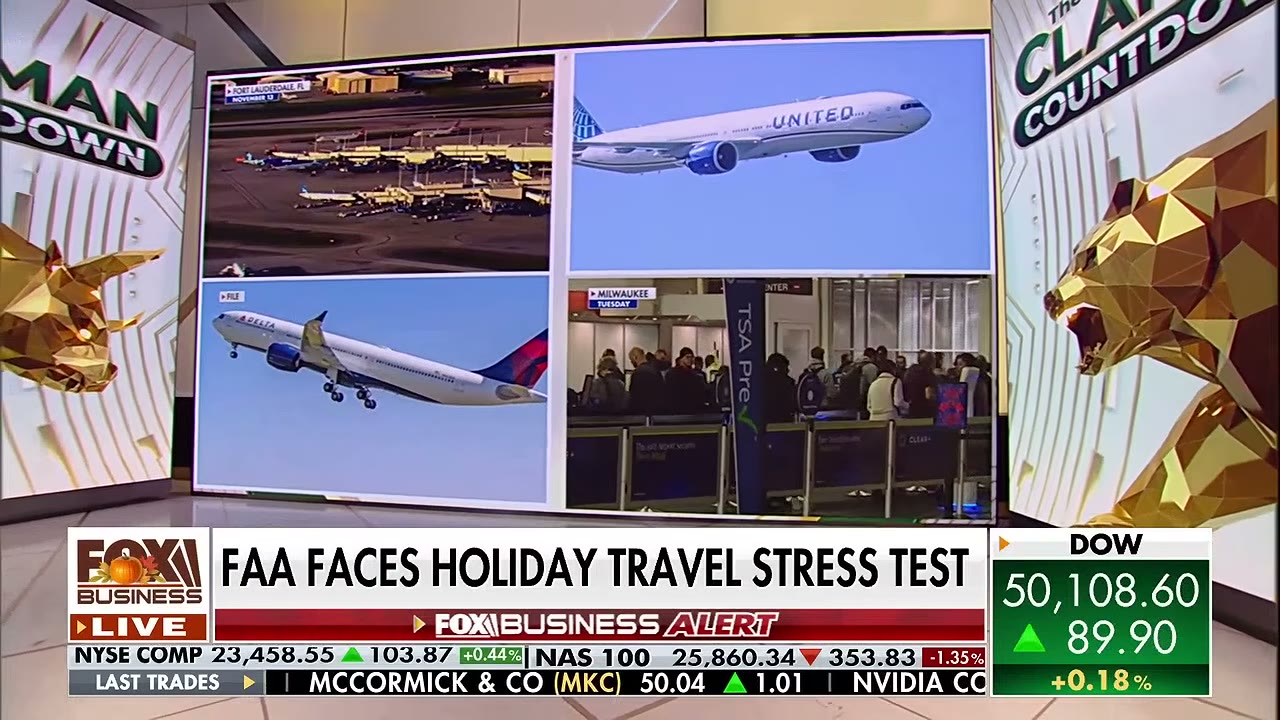
After a nationwide FAA outage, technical glitches at United and Delta and a radar outage at Chicago O'Hare, the Trump administration is deploying a rapid response team. Allied Pilots Association spokesman Captain Dennis Tajer discusses the cause, accountability and staffing.
1White House deploys rapid response team after FAA nationwide outage
A nationwide FAA outage has triggered the longest flight shutdown in the U.S. since 9/11, and the White House is now deploying a "rapid response team" to stop further large-scale disruptions. The crisis comes at the height of the holiday rush, with technical glitches also hitting United and Delta, and a radar outage at Chicago's O'Hare Airport.
Captain Dennis Tajer, spokesman for the Allied Pilots Association, which represents more than 15,000 American airline pilots, is weighing in. He has over 36 years of flying experience, including service as a pilot in the U.S. Air Force.
The administration's move signals growing alarm over a system under strain as millions travel.
2Pilots union backs rapid response team and FAA shutdown decision
Captain Dennis Tajer was stuck at Newark Airport during the nationwide shutdown — and he says stopping flights was the right call. "The people were incredibly calm and resilient," the Allied Pilots Association spokesman said. "But we cannot allow this to happen again."
Tajer called the White House's promised rapid response team "great news," saying experts from across the Department of Transportation, not just the FAA, need to be brought in. "The main goal is to make sure something like this doesn't happen again," he said.
He backed Transportation Secretary Duffy's decision to halt flying when security was at risk: "Instead of trying to work, hoping for success and a little luck, you stop flying. And this is the right decision."
3Pilot spokesman blames decades of neglect across administrations
Captain Dennis Tajer held up a Life magazine from August 9, 1968, and said reading it feels like reading about today. The Allied Pilots Association spokesman said the air traffic crisis has been accumulating for decades, with many administrations to blame.
"The bottom line is that we all share a share of responsibility, and we just need to do the job," he said. Everyone blames the government and the industry, he added, but the focus must be on fixing the system, preventing a repeat, and fully modernizing it.
He said professional pilots and those who watch the sky will ensure safety above all.
4Tajer calls for bipartisan funding and accountability on air travel
The Life magazine Captain Dennis Tajer cited is dated August 9, 1968 — and he called reading it "déjà vu all over again." The Allied Pilots Association spokesman said it shows "the nature of power, to put off until tomorrow what really needs to be done today."
Tajer said the union will support the Transportation Secretary and backs a bipartisan agreement that more funding is needed. But he stressed accountability: "Where does the money go? Are they being spent appropriately?"
He said government officials should keep politics out of the way while maintaining high accountability, noting nearly 3 million people fly every day. Pilots, controllers, mechanics and flight attendants have one mission, he said: safety first, reliability second.
5Four major air travel disruptions in two weeks fuel confidence crisis
Four major disruptions to air travel in just the last two weeks have fed a crisis of confidence among passengers, and it's not about crashing — it's about whether they'll reach their destination at all. The system is overloaded, and L3 Harris was at the center of the situation back on November 13, when the FAA's complete flight shutdown occurred.
The equipment is outdated, and the question now is what to do. Republicans point to the previous administration; the previous administration pointed to the previous Republican president.
Captain Dennis Tajer, spokesman for the Allied Pilots Association, said he doesn't like it when the issue is politicized. "No accusations," he said.
6Outdated FAA equipment and L3 Harris role in November 13 shutdown
The FAA has roughly 12,000 projects in the works, or 4,600, Captain Dennis Tajer said — and the question is why the outdated equipment wasn't addressed when funds were allocated. "This is not a matter of one switch," the Allied Pilots Association spokesman said. "This is the result of decades of work."
He said fixing it takes time and cannot be done instantly, and that the FAA has been open about what it's working on. He noted Secretary Buttigieg will appear before Congress to explain himself, and said the union isn't there to apologize for why it didn't happen.
"If you want to know who to blame, we're all in the same boat," Tajer said. "This is our home, and we will fix everything together."
7Pilot shortage concerns as Spirit bankruptcy reshuffles airline staffing
Spirit Airlines went bankrupt, and many of its pilots are moving to United, Delta and American — a reshuffle as airlines hire amid a system neglected for so long. Captain Dennis Tajer, at the end of his own career, said pilots keep retiring while people keep flying.
"There may not be many people on the roads for Jeff, but boy, were they all on planes," the Allied Pilots Association spokesman said. The union is demanding too much from an already overloaded air traffic control system, he added.
He said the industry must monitor everything and keep recruiting high-quality young professionals — pilots and air traffic controllers — calling them the key to success.
8Tajer says pilots and controllers, not AI, keep flights safe
When technology fails and communication deteriorates, it's trained pilots who use procedures to land the plane safely, Captain Dennis Tajer said. "The rest is just an addition," the Allied Pilots Association spokesman said. "But getting you safely on and off the plane is the most important thing."
He pushed back on the idea that AI is the answer: "It's just a tool, not the final answer." He said he's amazed at how calm pilots and air traffic controllers stay during incidents, and urged people not to yell at them.
"They do incredible work in very difficult circumstances," Tajer said.