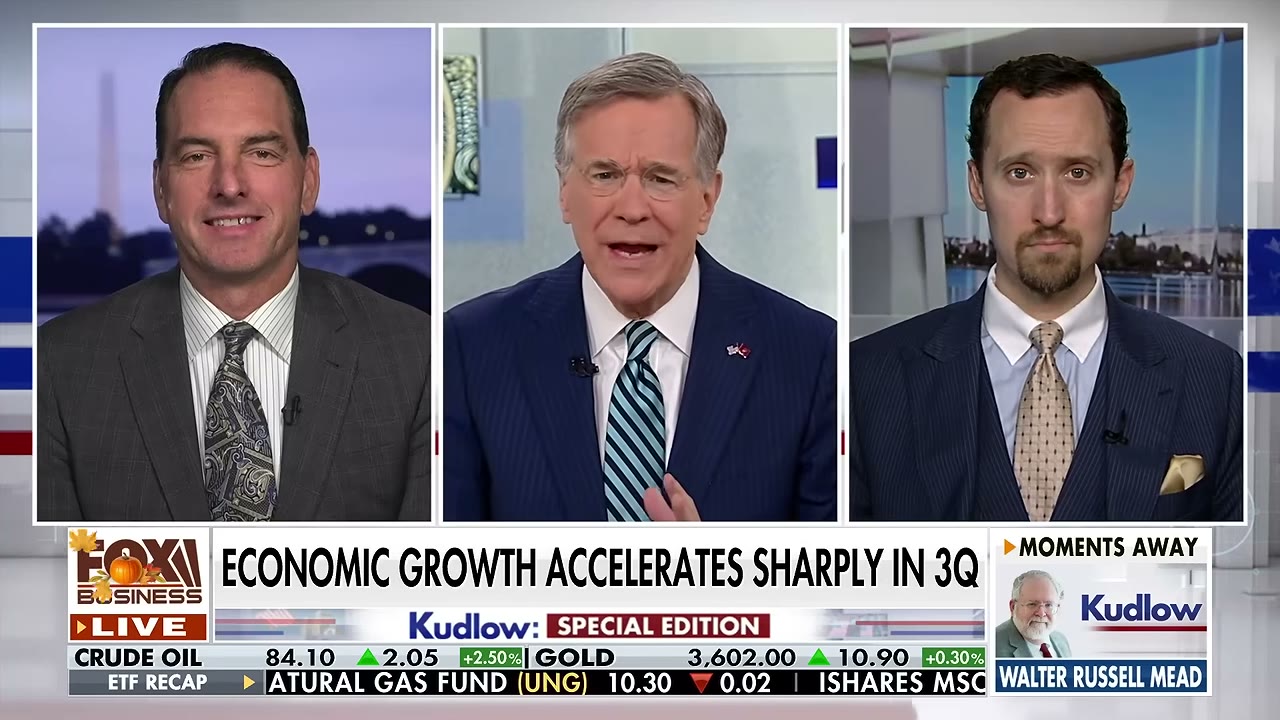
The US economy grew 4.3% in the third quarter, nearly a point above expectations, driven by strong consumer demand and business investment. Two economists debate whether AI investment can sustain growth, what it means for Federal Reserve rate decisions, and the timing of new tariffs on China and the EU.
1US economy beats forecasts with 4.3% third-quarter growth
The US economy grew 4.3% in the third quarter — almost a full percentage point higher than expected. Forecasters had predicted the figure would top 4%, and many doubted it. It happened anyway.
The data is real, not a regional Fed estimate. Consumer demand came in stronger than initial estimates indicated. Business investment is surging, with year-over-year growth in the third quarter that one guest described as "20% growth, even more."
Kevin Hassett said in a video that the numbers lay the foundation for increased productivity and revenue growth in the future. The indicators were high across all areas, according to the discussion.
2Guest urges Trump to keep deregulation and tax breaks despite new Congress
Factories, construction and data centers already underway will add capacity for strong domestic production, one guest said — and urged the president to stick with deregulation.
The guest also said tax breaks should be kept in place. That recommendation came as a new majority prepares to enter Congress in January.
The argument: the capacity being built now is a good sign for future reports, and high figures should continue.
3AI drives about 25% of US economic growth, raising correction risk
About 25% of US economic growth comes from artificial intelligence, according to the latest data — a big slice of the 4.3% third-quarter figure.
That raises a problem. The third quarter ended before the elections. It also ended before the AI meltdown now underway, one guest noted.
If AI's contribution is cut off, the guest warned, the country could face serious difficulties next quarter. The numbers being celebrated are looking back, not forward.
4Business fixed investment grows 16.1%, signaling long-term strength
Fixed non-residential private investment grew 16.1% last quarter — the category that funds factories, software and chips.
It is a key driver of long-term growth, one guest said. The previous two quarters grew 9.9% and 9.0%. Even with modest fourth-quarter growth, the category is on track to grow 10% this year.
Business investment provided at least half of third-quarter GDP growth, the guest estimated. The guest said this points to good numbers for 2027 in overall growth, productivity and real wage growth.
"Have we encountered a serious obstacle? Without any doubt," the guest said, but investment is expected to continue.
5Illinois paving company grows 10% using AI
A road construction company in Illinois grew 10% thanks to AI, its owner said.
Ravine Paving was founded by the owner's father, who never went to college but built it into a huge paving business working around the world on shopping malls and driveways.
The owner spoke about the gain. One guest argued such effects at real companies are not factored into the Barclays numbers on AI's impact on the economy.
6Record data center cancellations worth $64 billion raise alarm
Sixteen data center projects worth $64 billion were canceled in the last couple of months alone — a record number of cancellations.
One guest called it a big problem and said it may be bigger than the 25% AI growth figure.
The guest hoped the Fed takes the cancellations into account when considering raising rates because the economy is "too overheated," as the guest put it, describing how the Fed likes to talk.
7Experts argue Fed should not raise rates as inflation eases
There is no reason to raise rates by 50 basis points, one guest argued, because business investment creates room to grow without inflation.
Increasing production capacity in the US should not cause inflation even with high consumption, the guest said. The real drivers of inflation were energy prices and the war in the Middle East.
The guest expects the energy component of the November consumer price index to be negative, based on WTI oil and gasoline prices. Too many Keynesians and Phillips curve supporters at the Fed will still demand a hike, the guest said, but capacity expansion to meet demand suggests no inflationary pressure.
8Tax cuts and deregulation credited for sustained growth
Incentives — not AI — explain the growth, one guest argued, pointing to deregulation and tax cuts from Trump's first term and the second.
The guest cited a 2018 article from when the economy was growing over 4% per quarter and people said it couldn't be happening. The guest said stagnation under the Obama administration was reversed by the first Trump administration's stimulus, and the process repeated under the second with a big tax cut and removed regulations.
"It's all about incentives," the guest said.
9Deregulation called the hidden hero of the Trump administration
The second Trump administration has rolled back more regulations than any other, including the first Trump administration, which set a record at the time — eliminating over 120 rules for every new one introduced.
One guest called deregulation "the hidden hero" of the second Trump administration. Tax reform mattered too, the guest said, and fully attributing costs to business expenses works for AI development and the manufacturing renaissance.
The guest said the growth figures are a testament to that success, and that incentives matter "whether you have AI or not."
10Kevin Hassett defends new tariffs on China and EU
Exporters are cutting their prices to keep selling into the US rather than pass tariff costs on to American shoppers, Kevin Hassett said. The White House economic adviser defended the new tariffs proposed against China and the EU in a speech on Fox, arguing they are meant to level the playing field.
"The purpose of this tariff and previous forced labor tariffs is to level the playing field so that they treat us the way we treat them," Hassett said.
Critics warn the tariffs will push up prices for goods in the US. Hassett pushed back, saying that over the past few years exporters have largely absorbed the cost themselves to hold on to US market share, lowering prices back to pre-tariff levels when a tariff hits.
He also predicted the administration's deregulatory push will continue for the next two years, regardless of who controls Congress.
11Guest questions tariff timing amid AI market correction
One guest backed tariffs on China but questioned the timing, asking whether imposing them in the middle of a correction in the AI market is a good idea.
The guest said tariffs should hit China and any country that helps Chinese goods reach the US through third parties. The Chinese, the guest said, have engaged in forced technology transfers, intellectual property theft, slave labor and predatory resource extraction for years, if not decades, giving them an advantage that must be eliminated.
"I hope they will be limited," the guest said, urging that the measures focus on key national security areas rather than broader targets.
Going too general, the guest warned, would require exceptions — and those isolated decisions create a new set of problems.