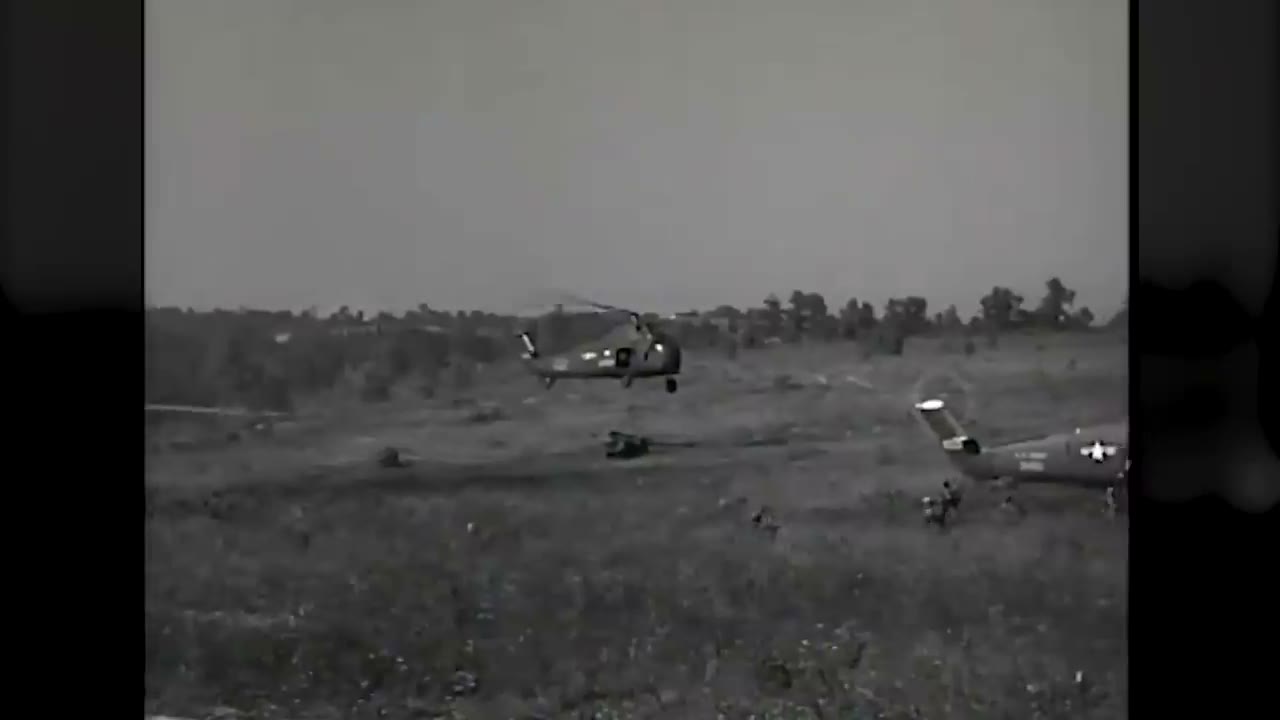
The video traces the 60-year evolution of divisional U.S. Army Air Cavalry, from Vietnam-era Aero-Scout, Aero-Rifle and Aero-Weapons troops to today's Apache and Shadow drone squadrons. It explains how reorganization, new helicopters and unmanned systems reshaped reconnaissance and security missions.
1Vietnam Air Cavalry's Origins and the 1961 ROAD Reorganization
In 1961 the U.S. Army roughly doubled the aircraft in its divisions. The shift came from President Kennedy's "flexible response" doctrine, which held that the Army should be able to fight both a nuclear big war and a non-nuclear small war.
That reversed the Eisenhower administration's strategy, which focused mainly on nuclear deterrence. Under the Reorganization of Army Divisions, or ROAD, the old Aviation Company became an Aviation Battalion with airlift and general support helicopters.
A company-sized Air Cavalry Troop was also added to the division's battalion-sized Armored Cavalry Squadron, alongside a headquarters troop and three armored cavalry troops. Airborne divisions got two airborne cavalry troops instead.
21st Cavalry Division Becomes Airmobile With an Air Cavalry Squadron
When the 1st Cavalry Division became an airmobile division in 1965, it got an Air Cavalry Squadron — the mirror image of an armored one. It had three Air Cavalry Troops and just one Ground Cavalry Troop, mainly mounted on jeeps.
The Air Cav Troop's job was to extend reconnaissance and security with both aerial and airmobile ground scouting. It suited undeveloped areas and rough terrain better than armored cavalry.
It was also a combined arms unit in its own right.
3Inside the Vietnam Air Cavalry Troop: Scouts, Rifles and Gunships
The Air Cav Troop's Aero-Scout Platoon carried SS-11 anti-tank guided missiles on armed HU-1B helicopters — enough to destroy enemy armor before it reached friendly forces.
The platoon had a headquarters with one H-13K observation helicopter, two light sections of four H-13s each, and a heavy section of four armed HU-1Bs. That gave the troop visual reconnaissance over large areas, useful for nuclear damage assessment and jungle operations.
The structure was a scaled-up version of the Sky Cavalry Platoon formed in 1957 to test airmobile tactics.
4Aero-Rifle and Aero-Weapons Sections Give the Troop Ground and Fire Power
Four nine-man rifle squads, carried in five utility helicopters, gave the Air Cav Troop the ability to seize lightly defended ground. The Aero-Rifle Platoon flew initially in UH-1Bs, later in long-body UH-1Ds.
The helicopters were first assigned to the platoon HQ, then split into a dedicated Airlift Section with its own lieutenant. The rifles could conduct ground infiltrations, ambushes and reconnaissance of canopy-covered jungle, set up observation posts and rescue downed aircrews.
The Aero-Weapons Section added four UH-1B or C helicopters with 2.75-inch rocket launchers to escort air assaults and isolate landing zones.
5Vietnam's Color-Coded Teams: Whites, Blues, Reds and Pink Teams
In Vietnam the troop's elements got color names: the Aero-Scouts were Whites, the Aero-Rifles Blues and the Aero-Weapons Reds. Two gunships made a Red Team; two light scouts made a White Team.
A composite team — one scout spotting targets and one or more gunships engaging — was a Pink Team. A gunship always operated with at least another gunship or an observation helicopter for target acquisition.
By the late 1960s the Air Cav Troop was largely similar, though new helicopters started to be introduced.
6Loach, Kiowa and Cobra Replace Vietnam-Era Helicopters
The OH-6 Cayuse, known as the Loach, replaced the OH-13 Sioux in the scouts under a 1967 table of organization. The improved UH-1H also began replacing the UH-1D in the Aero-Rifles.
By the early 1970s the heavy scouts were disbanded as the AH-1G Cobra arrived. The Aero-Weapons Section and its UH-1 gunships gave way to an Aero-Weapons Platoon with nine Cobras.
The OH-58 Kiowa began operating alongside the Loach in 1969, after the Army re-competed the light observation helicopter contract in 1967 over production issues and a Loach price hike. Bell's refined Model 206A won as the OH-58A.
7Aero-Scout Platoon Grows to Ten Helicopters and Persists Beyond Vietnam
The Aero-Scout Platoon grew from nine helicopters to ten around 1969, shortly before the Kiowa arrived. On paper that meant two helicopters in the platoon HQ instead of one; in practice, two sections of five.
Unlike the Aero-Weapons Platoon, the ten-ship scout platoon persisted beyond Vietnam. By 1979 reference data, change 10 of the table of organization, minor alterations appeared.
The 1st Aero-Weapons Section kept the initial AH-1G, but the 2nd was authorized four AH-1S helicopters equipped for the new TOW anti-tank guided missile. The Aero-Rifles were renamed the Recon Platoon, and the riflemen redesignated as scouts.
81979-1980s Tables Add TOW Missiles and Rename Riflemen as Scouts
By change 13 in the early 1980s, the UH-1 in the Troop HQ was replaced with a Kiowa. Both Aero-Scout Sections went back to four helicopters, for nine in the platoon.
In infantry, airmobile and airborne divisions, the number of Recon Squads fell from four to three, with only four UH-1Hs to lift them. Armored and mechanized divisions kept four squads.
Both Aero-Weapons Sections were equipped with the TOW-capable AH-1S. Then came the Army of Excellence reorganization.
9Army of Excellence Strips the Troop to Scouts and Attack Helicopters
The Army of Excellence reorganization cut the troop to its bones: an Aero-Scout Platoon with six OH-58C scout helicopters and an attack helicopter platoon with four helicopters.
The service platoon was removed entirely, with maintenance and supply centralized at squadron level. The troop headquarters was stripped back significantly, and the ground reconnaissance capability was disbanded.
Division 86 plans in the early 1980s anticipated the AH-64 Apache. By the end of the 1980s, Air Cav Troops outside Europe still fielded AH-1S helicopters; the AH-64A was fielded by Air Cavalry in Europe alongside the Cobra and deployed from Germany to Saudi Arabia during the Gulf War.
10Army of Excellence Reshapes Squadron Mix and Moves Cavalry to Aviation Brigades
Under Army of Excellence, heavy division cavalry squadrons got two ground and two air cavalry troops. Light divisions got two light ground and two Air Cav Troops.
The air assault division got four Air Cav Troops plus about a company's worth of UH-60 Blackhawks in the headquarters troop, but no ground troops. The airborne got three Air Cav Troops and a motorized ground troop.
Aviation battalions and squadrons added an Aviation Unit Maintenance Company in 1989 or 1990, and Division Cavalry Squadrons moved to the new Division Aviation Brigades — despite their ground recon elements.
111990s Force Projection Simplifies the Troop to Two Platoons
By the late 1990s, under the Force Projection series of tables of organization, the Air Cavalry Troop was simplified to two platoons of four aircraft each.
In most divisions those could be entirely OH-58 armed scouts or AH-1 attack helicopters — but no longer a mix within the same troop.
At squadron level, heavy division cavalry added a third ground troop, as had been desired in the mid-1980s but not resourced under Army of Excellence. Light infantry divisions had lost one of their ground troops sometime in the 1990s.
122004-2006 Modular Force Reform Replaces Divisional Cavalry With BCT Squadrons
The division's run as a proper tactical unit ended in the mid-2000s. Under the Army's 2004-2006 Modular Force reform, brigades became permanently self-contained, independently deployable units of action.
Before, an armored brigade was normally task organized into a brigade combat team by its parent division; that configuration became permanent. Divisional cavalry assets were replaced by Reconnaissance Squadrons at brigade level — but those had no aviation.
Aviation brigades became "aviation units of action" with three designs.
13Aviation Brigades Adopt Heavy, Medium and Light Designs
Every aviation unit of action had two attack reconnaissance formations, one assault helicopter battalion, one general support battalion, one aviation support battalion and a headquarters. The difference was in the aircraft.
Heavy design: two AH-64 Apache attack recon battalions under Aviation Regiments. Medium: one battalion was a Cavalry Squadron with Kiowa armed scouts. Light: both were Kiowa Cavalry Squadrons.
The heavy 1st Air Cavalry Brigade got 1-227 and 4-227 as attack battalions. The medium 82nd Combat Aviation Brigade had 1-17 Cav as a Kiowa squadron. The light 25th Combat Aviation Brigade included 2-6 and 6-17 Cavalry as Kiowa squadrons.
14Composite Kiowa-Apache Teams Revive the Vietnam Pink Team Concept
A Kiowa scout helicopter became the mission commander for an Apache gunship — the scout directing the far more heavily armed attack helicopter. In the 10th Mountain Division, elements of the Kiowa-equipped 6-6 Cavalry and Apache-equipped 1-10 Aviation formed a composite flight company with 6 Kiowas and 6 Apaches.
Even units that didn't integrate the two helicopters in the same companies — which was basically all of them — had doctrine for task organizing dual scout weapons teams. In one setup, a Kiowa Warrior acted as wingman and air mission commander while an Apache acted as the lead.
The Kiowa, ideally manned by a troop commander, platoon leader or senior warrant officer, would direct the team, recon the objective, communicate with higher up, mark targets and coordinate with ground forces. The Apache would engage targets, protect the Kiowa, and guide the Kiowa if the Apache made contact with the enemy first.
That was the ultimate evolution of Vietnam's Pink Team, with OH-13 scouts and UH-1B gunships, and the later OG Kiowa and Cobra Scout/Weapons Teams that persisted into the 90s.
152013 Reorganization Creates Standardized Air Cavalry Squadrons With Shadow Drones
A sweeping Army reorganization announced in 2013 pushed the OH-58D Kiowa Warrior out of the scout role and put the AH-64 Apache in its place. In light Aviation Brigades, the Attack/Recon Squadron converted from Kiowa Warriors to Apaches.
In heavy divisions, one of the Attack/Recon Battalions reflagged into an Attack/Reconnaissance Squadron, later called an Air Cavalry Squadron. To set them apart from the Apache-only Attack Battalions, three platoons of RQ-7 Shadow drones were added to the squadron.
The standardized Air Cavalry Squadrons took shape in the 2015 to 2016 time frame. Earlier efforts to save the armed scout did not succeed.
16Today's Air Cavalry Squadron: Mission, Troops and Apache Platoons
Every divisional Combat Aviation Brigade now fields one Air Cavalry Squadron with the same design, whether the division is light or heavy. It provides accurate and timely information to the commander through reconnaissance missions, gives the division time and space to react through security missions, and can defeat, delay, divert and disrupt enemy forces through security or strike missions.
The squadron includes a headquarters and headquarters troop, 3 air cavalry troops, an aviation maintenance troop and a forward support troop for multifunctional logistics. Each air cavalry troop has a small Troop HQ, 2 Attack/Recon Platoons and a Shadow Unmanned Aircraft System platoon.
Each Attack/Recon Platoon consists of 4 Apaches, led by one Lieutenant as Platoon Leader, with the rest of the pilots Warrant Officers. Ground-based crew chiefs are also allotted to the platoons.
The platoons are authorized fewer pilots than needed to man all the Apaches because the Company Commander and three Warrant Officers in the Troop HQ also act as pilots. The Apache-only Attack Battalion has the same mission profile but is less capable in reconnaissance and security tasks due to the lack of organic drones.
17Scout Weapons Teams and Longbow Radar in Current Apache Operations
Three Longbow fire control radars sit in each troop — the saucer mounted above the rotor on some Apaches. As a separate piece of equipment from the helicopter itself, the radar can be installed on any Delta or Echo Apache to track up to 128 targets and engage them simultaneously.
In combat, the platoons are mainly administrative constructs. Apaches would be task-organized into elements as small as a two-ship Scout Weapons Team.
In the late 90s, it was assumed that an attack helicopter company with 8 helicopters would functionally have 6 helicopters, or 3 scout weapons teams, with 75% fully mission capable at any time. Each team would have either the company commander or a platoon leader to provide mission command — though if all helicopters are in the air, one would presumably be left with a senior warrant officer in charge.
In footage, the Longbow-equipped Apache is often seen paired with those without, as target data can be shared with other Apaches.
18Shadow Drone Platoon Provides 24-Hour Coverage and Laser Designation
An unarmed Shadow drone can laser-designate a Hellfire for a concealed Apache to fire — the same buddy-lazing trick Kiowas once performed. The Shadow carries sensors and a laser designator that can guide in Hellfires launched by an Apache it can see but the enemy cannot.
The Shadow platoon has the equipment to launch, recover and control 4 RQ-7BV2 Shadow UAVs. With an endurance of about 9 hours, the platoon is equipped to conduct up to 3 missions a day to provide 24-hour coverage.
It can surge up to 2 drones in the air at once for more aerial surveillance coverage, but unsustainably.