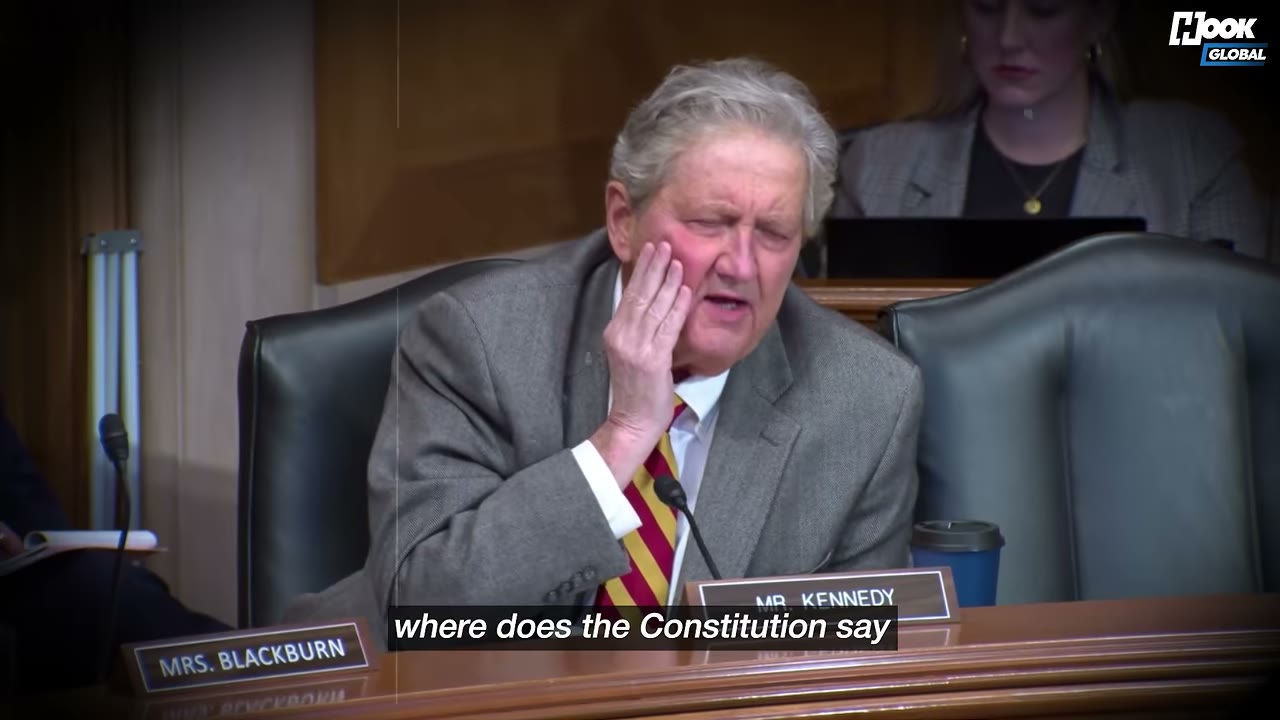
A Senate hearing exchange between Republican Senator Kennedy and a Trump judicial nominee over constitutional basics, including where the Supreme Court gets power to strike down laws. The nominee says he is unfamiliar with the provision, while affirming that everyone deserves a lawyer.
1Nominee Cannot Name Constitutional Provision for Judicial Review
A Trump judicial nominee could not say where the Constitution gives the Supreme Court power to strike down laws. Senator Kennedy asked the question directly: where does the Constitution say the Supreme Court can declare a state or federal law unconstitutional?
The nominee answered: "I am not familiar with this particular provision."
Judicial review is the power behind landmark rulings that have struck down laws for more than two centuries. The nominee's exchange came during his confirmation hearing before the Senate.
Kennedy, a Republican, pressed the point. The answer drew attention because the power is central to what federal courts do.
2Nominee Explains Gideon v. Wainwright Right to Counsel
A Trump judicial nominee stumbled when asked to explain one of the Supreme Court's most famous rulings on the right to a lawyer. Senator Kennedy asked what Gideon v. Wainwright decided.
The nominee described it as a Supreme Court case that gave criminal defendants the right to counsel in serious crimes.
Gideon v. Wainwright is the 1963 ruling that established that defendants facing serious criminal charges have a constitutional right to an attorney, even if they cannot afford one.
The question came after the nominee said he was not familiar with the constitutional provision for judicial review.
3Kennedy Presses Nominee on Lawyers Representing Unlikeable Clients
Senator Kennedy asked whether the right to a lawyer comes with a catch: must the attorney agree with the client's behavior? The nominee said no.
Kennedy asked whether Gideon v. Wainwright said defendants get an attorney "only one who agrees with their behavior." The nominee replied: "Of course not, Senator."
Kennedy then asked whether any constitutional or ethical rule requires a lawyer to agree with a client's conduct. The nominee said no, and said the rule of law requires representation for parties.
The questioning tested whether the nominee would defend unpopular clients. He said lawyers must represent them regardless.
4Nominee Says He Represented Over 300 Clients Without Sharing Their Views
A Trump judicial nominee said he represented more than 300 clients in private practice and disagreed with many of them. Senator Kennedy asked how many clients he had handled. The nominee estimated hundreds, probably more than 300.
Kennedy asked whether he agreed with each client's behavior. "Of course not, Senator," the nominee said.
Kennedy asked whether he quizzed clients on abortion or climate change to check their politics aligned with his. The nominee said he does not do that.
Kennedy called that appropriate, saying polling clients on politics would be inappropriate.
5Kennedy Asks Whether Egregious Municipal Defendants Still Get Counsel
Senator Kennedy asked whether even a "real jerk" still gets a lawyer. The nominee said yes.
Kennedy posed a scenario: defending a municipality in a 1983 lawsuit where the alleged misconduct was egregious and the person involved was "a real jerk." Did that person still have the right to an attorney? "That's right, Senator," the nominee said.
Kennedy pressed again: were they saying everyone has the right to protection except idiots? The nominee again agreed.
The exchange came as Kennedy tested whether the nominee would defend clients whose conduct he found distasteful.
6Nominee Again Fumbles Question on Constitutional Basis for Judicial Review
For the second time, a Trump judicial nominee said he was not familiar with the constitutional provision granting judicial review. Senator Kennedy asked where the Constitution gives the Supreme Court power to declare a state or federal law unconstitutional.
"I am not familiar with this particular provision, Senator," the nominee said.
The nominee pointed to Marbury v. Madison, saying the case gives the Supreme Court the final say on constitutionality. Kennedy asked where the Constitution says that. The nominee cited powers under Article III and said the practice has been accepted as part of the nation's history and tradition.
Earlier in the hearing, the nominee had given the same answer to a similar question.
7Nominee Defines State Police Power Under the Tenth Amendment
Asked to define state police power, a Trump judicial nominee turned to the Tenth Amendment. Senator Kennedy asked what state police power means and how state legislatures apply it.
The nominee said that under the Tenth Amendment, any powers not expressly granted to the federal government are reserved to the states within the system of federalism.
The Tenth Amendment is the part of the Bill of Rights that reserves undelegated powers to the states or the people.
The question came as Kennedy walked the nominee through constitutional basics.
8Kennedy Says Nominee Will Likely Be Confirmed
Senator Kennedy told a Trump judicial nominee he will probably be confirmed. Kennedy said he thinks the nominee would make a good federal judge.
Kennedy asked whether the nominee had read the Constitution — all seven articles and 27 amendments. The nominee said yes.
Kennedy then urged him to protect people regardless of their political beliefs. "Everyone has the right to a lawyer," Kennedy said.
The Republican senator's prediction suggests the nominee has support ahead of a confirmation vote.