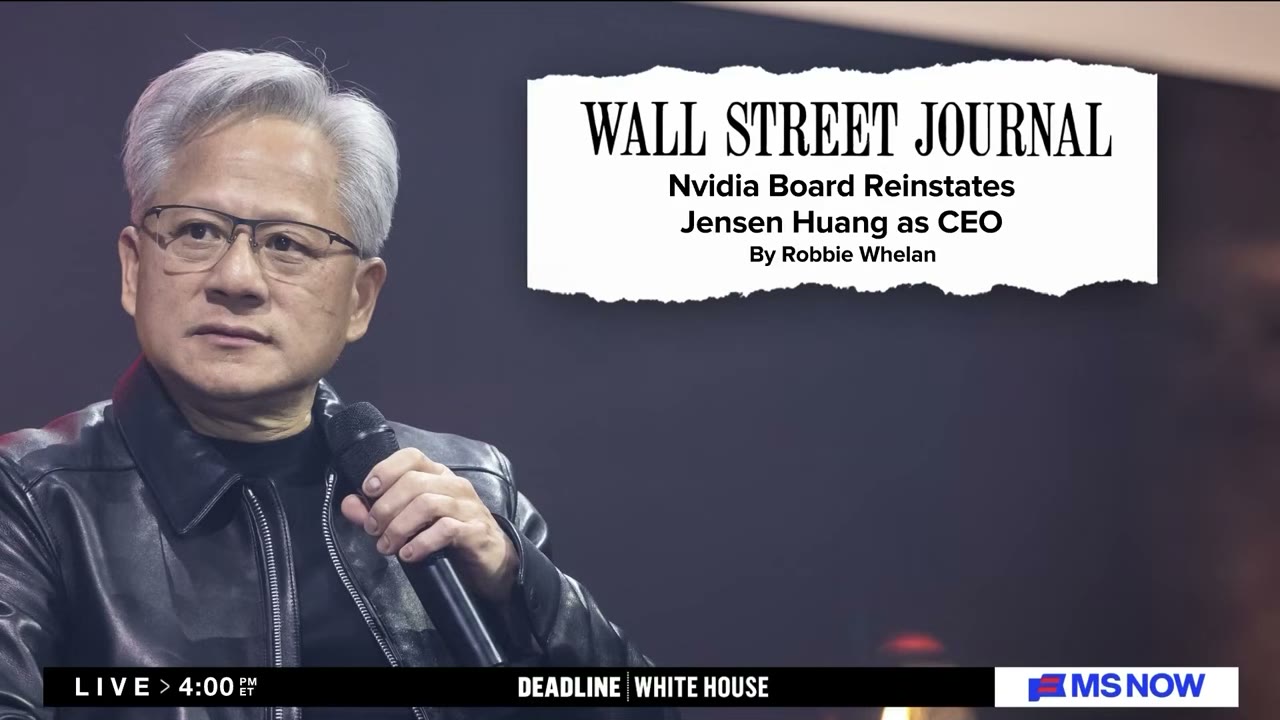
The Pentagon considered invoking the Defense Production Act to pressure Nvidia's board to restore Jensen Huang, who was ousted over an affair with a woman tied to Chinese intelligence. Trump admits intervening, and his Nvidia holdings jumped as the stock soared.
1NVIDIA board reinstates Jensen Huang after 12-day exile over spy affair scandal
NVIDIA's board brought back CEO Jensen Huang after a 12-day exile, saying U.S. government input convinced it he poses no national security risk. Huang resigned this month after reports of an extramarital affair with a woman alleged to be a Chinese government spy, plus a second affair with a direct subordinate. The board had refused reinstatement calls until now. Its statement said: "the board received input from senior levels of the US government."
2Trump admits personally intervening to push NVIDIA board to rehire Huang
President Trump said his personal intervention was "very important" in getting NVIDIA's board to rehire Jensen Huang. Trump's stake in NVIDIA had ballooned to as much as $62 million before the scandal, according to The Washington Post. He said he spoke to the board "directly and indirectly" but wouldn't say who. Asked whether Huang would have returned without him, Trump said: "the answer is no." He said he was "doing it for the country."
3NYT: Woman in Huang scandal kept contact with Chinese spy agency for over a year
The Chinese woman at the center of the NVIDIA scandal kept in contact with an official of China's top spy agency for more than a year while carrying on a secret affair with Jensen Huang, according to New York Times reporting citing people with knowledge of U.S. intelligence. Intelligence also indicated her business partner, Kang Wei, often introduced as her husband, worked with the same agency. Advisers told Trump at least twice before the scandal broke that intelligence had uncovered her links, officials said. He downplayed the concerns.
4Kara Swisher: Trump's Huang reinstatement is 'bordering on traitorous'
Journalist Kara Swisher said Trump's move to usher Jensen Huang back into NVIDIA is "bordering on traitorous," arguing severe national security issues don't vanish because the president wanted to boost his stock. She said Republicans, including Newt Gingrich, also spoke out and called for Congress to investigate. But she warned probes will be hard while Trump controls the CIA and national security agencies. "He was briefed," Swisher said, rejecting Trump's denial.
5Swisher warns NVIDIA chips reaching adversaries pose national security threat
NVIDIA chips are turning up in drones Russia uses to attack Ukraine, with China supplying Moscow the technology, journalist Kara Swisher said. She argued the spread shows the chips reach places they shouldn't, and questioned Huang's leadership. "He's not a very good CEO if he doesn't know where his chips are going," she said. Swisher said Huang has pushed to sell some chips to China, backed by Commerce Secretary Howard Lutnick, while Treasury Secretary Scott Bessent and Secretary of State Marco Rubio raised concerns.
6Swisher: Trump trading national security for stock market gains
Journalist Kara Swisher accused Trump of trading away national security to prop up the stock market, saying shareholder value matters less than American public safety, including in the military. She warned the chips could be used against the U.S. in bombs and nuclear weapons. "It's bordering on traitorous," she said. Swisher said she wants to know how chips reached China that weren't supposed to be there, and predicted NVIDIA's board faces lawsuits and investigations.
7Democrats win historic 258-seat House majority despite GOP gerrymandering
Democrats will control at least 258 House seats come January, the largest majority either party has held in the chamber in more than three decades. The New York Times reported they overcame a flurry of Republican-led gerrymandering that gave the GOP a structural advantage going into Election Day. The race that clinched the number: North Carolina's 5th District, where former newspaper reporter Chuck Hubbard defeated 11-term Republican incumbent Virginia Foxx after a recount confirmed his win by just over 300 votes.
8Analyst Eddie Glaude: voters punished Republicans for a decade of complicity
Princeton professor and political analyst Eddie Glaude said the American electorate chose to punish Republicans for their complicity over the last decade, and that the party had demonstrated it should not be given power. He said voters across the board, including in red districts, agreed. "We pumped the brakes as we were heading toward the cliff," he said. He cautioned the hard work begins now, but said the wins should be celebrated.
9Black and Brown voters drove Democratic wins, setting record seven Black senators
Seven Black senators will serve together next year — a historic first since Reconstruction, when only 14 Black U.S. senators have served in total since the 1970s. Black and Brown voters turned out in force, reacting to redistricting efforts to wipe out Black representation in urban areas and to treatment of Hispanic families and neighbors. "It makes democracy sing," one analyst said of the response. Trump voters did not turn out at previous levels, while independents swung the other way.
10CIA and ODNI discover breach exposing open source intelligence systems
The CIA and the Office of the Director of National Intelligence recently discovered a breach that exposed some unclassified information, a U.S. official said. The breach has since been fixed. The New York Times, which first reported the news, said the compromised system analyzes open source intelligence — commercially available data sets, social media content, satellite imagery and other online material that can be highly revealing when combined. It follows other disruptions, including an NSA outage and a breach of the FBI's nationwide crime database.
11Analyst: breach reveals what intelligence agencies are prioritizing
The real danger in the intelligence breach is what hackers may learn about what the CIA and DNI are looking for, an analyst said. That reveals the government's requirements and prioritization for collecting information. The analyst said it's good that only unclassified, open source systems were affected, but the breach highlights the importance of GPUs, which can power advanced AI models that produce cyber weapons and uncover unknown weaknesses in adversary networks. Keeping export controls, the analyst said, keeps defense ahead of offense.
12Ben: AI boosts offensive cyberattacks amid least competent government
AI is dramatically enhancing offensive cyberattacks just as the least competent group of people in a lifetime runs the U.S. government, including its cyber defenses and intelligence community, an analyst said. He warned that Americans rely on trustworthy officials to explain hacks and data compromises credibly, but said the people running these agencies won't even say under oath whether Trump lost the 2020 election. "We are flying blind here a bit," he said, adding that Congress could play a greater role in reporting information.
13Julia: Trump has done generational damage to intelligence agencies
Trump has already done generational damage to several intelligence agencies and the Defense Department, an analyst said, gutting a generation of talent and expertise. People were driven out or targeted, and hundreds more decided the profession wasn't worth living in fear of being fired for saying the wrong thing, she said. She said it matters whether rebuilding starts in 2029 or 2033 — by 2033, a generation will have moved on. One former official said the intelligence community could survive one Trump term, but not two.
14NVIDIA stock swings wildly on Huang resignation and return
Nvidia stock fell double digits after Jensen Huang resigned, then soared 31 percent when he returned as CEO — regaining about $1 trillion in lost market value. The Nasdaq 100 dropped more than 5 percent during the selloff, wiping out its gains for the year.
The Dow gained 1,400 points, its third thousand-point gain this month, and the S&P 500 rose nearly 5 percent. The swings followed what was described as an Nvidia scandal involving a Chinese spy affair.
Charlie Wurzel of The Atlantic called it a "hostage situation," writing that America faces two bad choices: let AI rip while tech leaders act with impunity, or watch the economy enter a recession.
15Raskin says Trump's Nvidia stake drove Jensen Huang's return
Donald Trump's Nvidia holdings rose up to $15 million in a single day as shares jumped over 30 percent on news of Jensen Huang's return, according to numbers crunched by the Financial Times.
Congressman Jamie Raskin said the move was transparent. Asked whether Trump's stock ownership drives his decisions on companies, Raskin said: "If you don't believe that, you're too innocent to be let out of the House by yourself."
Raskin noted Trump openly declared he made more than $2 billion on the side in his first year in office. The $15 million figure is based on holdings as of September 30th.
16Kara Swisher says Trump reinstalled Huang to protect himself
Kara Swisher said Donald Trump had to put Jensen Huang back in place "in order to protect himself," pointing to the money and national security stakes around Nvidia.
Swisher flagged the stock trades surrounding the company, citing one person who invested $3.4 million and came out with $312 million. She said the trading around the company has to be massive and full of information.
"It's not a money thing. It's a sex thing. It is a national security thing," Swisher said, describing the mix of economic and financial concerns driving the decision.
17Panel digs into corruption and reliance on Nvidia
Jonathan Swan has reported that the chips ending up in China may not have broken U.S. export laws — but that won't get Jensen Huang off the hook, according to MS Now senior business analyst Stephanie Ruhl.
Ruhl said the questions now turn to Howard Lutnick and Donald Trump over why export regulations were loosened to make it easier to sell chips to China than to Canada. She noted DNI Clayton said Sunday that the most valuable chips must not reach China, and by Monday night Todd Blanche was asked about an investigation into Huang and replied, "What investigation?"
Ruhl said the president pressured the board of a company to reinstate Huang. "This thing ain't over," she said.
18Panel debates what export controls actually allow
The U.S. can sell some chips to China but not its highest-value ones, and a panel debated whether the Trump administration is loosening those controls for the wrong reasons.
MS Now senior business analyst Stephanie Ruhl said the economy has had only one trade for two years — the AI trade — which she said has never had anything to do with Main Street. She argued tight export controls on chips to China are still needed.
She compared it to American soybean farmers: "We loosened up our export controls, and we're willing to sell the most highly valuable, dangerous things to China, but I couldn't sell my soybeans for what?"
19Senators expect Huang to take the Fifth on Capitol Hill
Republican Senator Kennedy said he expects Jensen Huang to take the Fifth to avoid incriminating himself in a prosecution, according to a panel discussion on Capitol Hill friction.
Republican senators expect a criminal investigation is underway or will soon begin, and that the Cabinet will have to answer national security questions. One panelist said the president and administration members likely knew what was going on — a "knowing ignoring" of their own export ban rules on the chips.
The panelist compared it to Iran-Contra, going around Congress's ban, and quoted a line that a scandal is when more than half the harebrained rumors turn out to be true.
20Washington Post: Pentagon weighed Defense Production Act on Nvidia
Pentagon leaders weighed invoking the Defense Production Act — a Cold War-era law — to pressure Nvidia to restore Jensen Huang as CEO, The Washington Post reported, citing three people familiar with the conversations.
The 1950 law grants the president broad authority to intervene in the economy and has been used to mobilize companies in wartime or national emergencies; the first Trump administration used it to prompt General Motors to produce ventilators during COVID-19. A Pentagon official denied to the Post that any such conversations happened.
One Trump administration official said the law could be used to force Nvidia to shift more production to military projects, which could have curbed its production plans and profits. Nvidia stock was down 5 or 6 percent in trading.
21Andrew Weissman calls using the DPA outrageous
Andrew Weissman called it "outrageous" if the reporting is accurate that the Defense Production Act was used to pressure Nvidia's board over Jensen Huang's return.
Weissman said the DPA is a congressional statute meant to give the president power in national emergencies to protect the country — not to help a company selling tens of millions of dollars of chips that found their way to an adversary. "It is beggars belief that this is a statute that anyone would have thought you could use in this situation," he said.
He said it doesn't matter whether it was intentional or lax controls: the products were ending up at an adversary in a way that could be used militarily against the U.S.
22Weissman says money drove Huang's reinstatement
Asked why the entire cabinet worked to replace a CEO who had a relationship with a Chinese spy and was released by his board, former prosecutor Andrew Weissman answered with one word: "Money."
Weissman described an "unholy alliance of Wall Street, tech bros and Donald Trump." He said there was personal gain reported for Trump and for Howard Lutnick and companies associated with him, and that profit was put over national security interests.
He said invoking the DPA — meant for America first in national emergencies — for a company selling products indirectly to an adversary tells you how the administration misunderstands its role as public servants.
23Rev. Sharpton asks whether Trump will sell out anyone
Rev. Al Sharpton asked whether there is anyone Donald Trump won't sell out, saying he has never seen or heard of one, and pointed to the timing: Thanksgiving Eve, when people say they can't afford what they're putting on the table.
Sharpton said the White House is trying to stretch the Defense Production Act to defend someone who was sleeping with a spy possibly giving information to an adversary. He also cited the Defense Department lending somebody $15 billion while families worry about dinner prices.
"There's no moral code at all that you're dealing with," he said, adding his hope that enough Republicans in the Senate and Congress will stand up.
24Atlantic's Wurzel explains the 'Nvidia state' hostage logic
Charlie Wurzel of The Atlantic writes that "you, me, and Donald Trump, we all live in an NVIDIA state" — one that governs by the logic of a hostage situation, not a democracy.
Wurzel said the market selloff after Jensen Huang resigned, then the 30 percent jump when he was reinstated before markets opened Monday, showed Silicon Valley's argument: Huang is basically a one-man economy, and without him the AI boom stops.
He described the feeling as: "Oh, it's a nice economy you got there. If you don't let this guy do what he wants to do, the music might stop, you could lose it all."
25Public has little choice through index and retirement funds
Many Americans are invested in the Magnificent Seven tech companies through index funds and retirement funds whether they want to be or not, making the choice around AI even harder, according to a panel discussion.
One panelist said a big part of the problem is the mindset in Silicon Valley — that leaders there are presiding over transformational technology the rest of the world doesn't understand, and they don't really want the public's input.
They want to build it and be left alone, the panelist said, believing they can make decisions that are increasingly about humanity, the economy and agency.
26Wurzel says Trump will protect tech leaders who keep economy up
Donald Trump has made it clear: if you make him money as a shareholder and keep the economy going up, he wants to protect you, Charlie Wurzel of The Atlantic said.
Wurzel said Trump intervening in the board of a publicly traded company is a signal to tech leaders that they will be protected if they keep the economy — which he said is the last thing going OK for Trump — moving. He noted Trump is an Nvidia shareholder and has made money off the stock over the past couple of weeks.
One panelist pushed back, noting 90 percent of Americans don't think the economy is working for them, and that the prevailing view inside the industry is not the view among the populace.
27Applebaum details Nvidia chips in Russian drones and missiles
American-made Nvidia chips have ended up in Russian drones and missiles used to kill Ukrainians, according to Anne Applebaum. She said the chips involved are not the high-end ones at the center of the controversy, but more ordinary ones.
Nvidia was originally banned from selling chips to China under the Biden administration, which feared they would power the Chinese military or AI industry. An exception was later made, and Applebaum said it is unclear why.
She warned the supply chain doesn't stop in China. "If you sell something to China, you can't track it after that," she said, adding the chips could reach Iran or North Korea.
28Trump downplays Nvidia national security concerns as a joke
President Trump is downplaying a national security story as if it were a tale of infidelity, according to Anne Applebaum. She said his public comments and social media memes treat the matter as a joke.
She said Trump has known about the issue for many months, not the few days he has claimed when asked about it.
"It's not a story of infidelity," she said. "It's a story about national security, and it's a story about corruption." She said the open question is why the president was persuaded to act as he did.