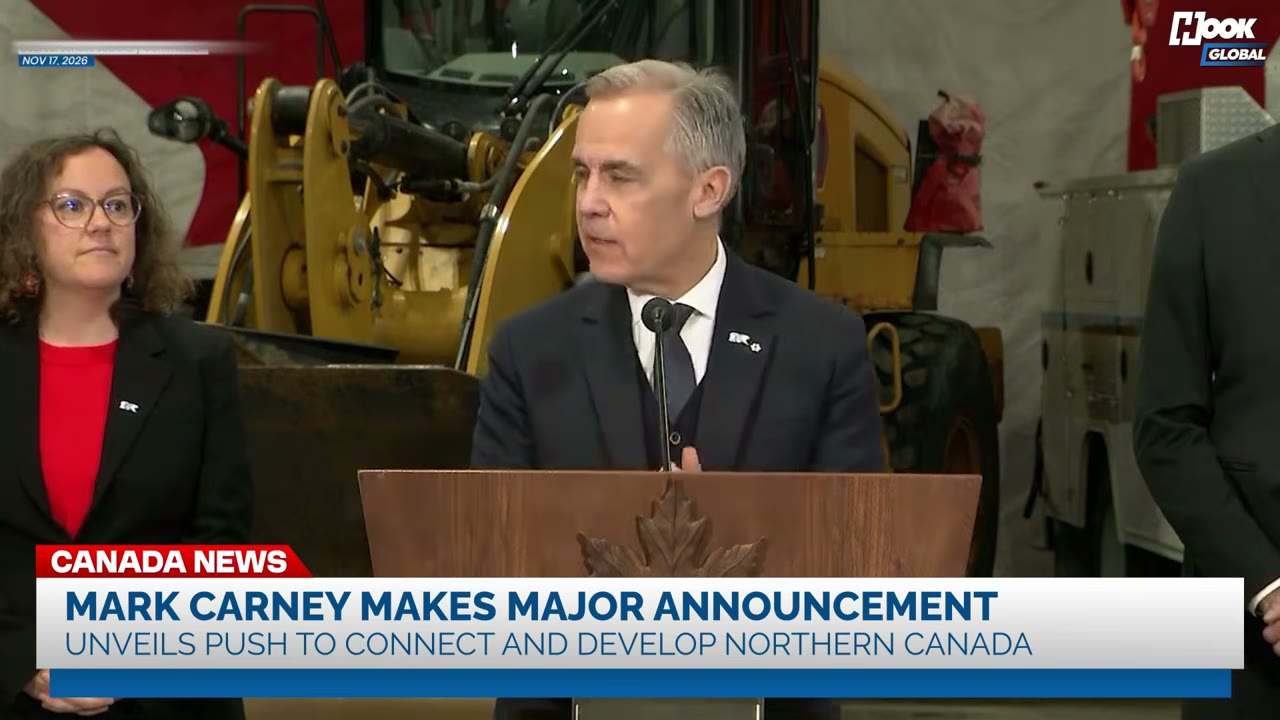
Mark Carney designated the Mackenzie Valley Highway a nationally significant project and committed more than $3 billion in Budget 2026. He also signed seven new trade deals, funded an Arctic corridor, and faced questions on rights and reconciliation.
1Carney says connectivity strengthens Canadian sovereignty in Yellowknife speech
Mark Carney told a Yellowknife audience that roads and trade are tools of national sovereignty, saying "Connection brings strength." The prime minister said Canada's sovereignty means the ability to live as we choose across the country, and that it is built on strength at home and diverse partnerships abroad.
He recalled being born in Fort Smith, when the only way south was the winter road. A year later, an all-season road to Gay River opened, bringing more opportunities, he said.
Carney said Ottawa's investments in large-scale projects and local infrastructure are driven by that principle, and that Canada is building a network of trusted partnerships to reduce dependence on a single market.
2Canada signs seven new trade deals and opens seven more negotiations
Canada has signed seven new trade and investment agreements since March and launched negotiations on seven more, Carney said in Yellowknife.
The prime minister said the country now has 20 free trade agreements covering 60 countries, giving preferential access to over two billion consumers — more than two-thirds of the world's GDP.
"We are just getting started," he said, framing the deals as part of a push for less dependence on a single market.
3Ottawa pushes domestic trade corridors, power lines and high-speed rail
Ottawa is planning new roads to critical mineral deposits in Ontario's "Ring of Fire" and new power lines to spur growth in northern British Columbia, with the BC grid eventually connecting to the Yukon.
Carney said the work would double grid capacity across the country and connect power systems in the east, west and north.
He said the government is also exploring high-speed rail from Toronto to Quebec and from Edmonton to Calgary, and breaking down barriers to trade between provinces and territories. "It's high time to unite the North," he said.
4Canada designates Mackenzie Valley Highway as nationally significant project
The Mackenzie Valley Highway has been almost 70 years in the making, and Ottawa is now officially designating it a nationally significant project under the Canada Development Act.
The 800 km all-weather road from Wrigley to Inuvik will connect Tulita, Norman Wells and Fort Good Hope to the Southern Highway year-round for the first time. It cuts the road distance between Yellowknife and Inuvik by 1,300 km.
In September, Ottawa announced more than $400 million for a bridge over the Great Bear River, an access road to Prohibition Creek and design work for two more bridges.
5Carney explains what national project designation means for the highway
Ottawa will negotiate the Mackenzie Valley Highway as a single entity, part of what Carney called a new approach to construction on major projects.
He said the designation unites federal agencies at the table, simplifies processes and gives communities, Indigenous governments, the territory and builders a clear view of the government's position.
The Major Projects Office will coordinate financing and implementation, and the project will face a treaty-based environmental review and the Northwest Territories regulatory regime, including an assessment by the Mackenzie Valley Environmental Impact Assessment Board. Consultations starting now will shape a terms of reference document.
6Ottawa, territory and Indigenous groups sign highway governance agreement
The Government of Canada, the Government of the Northwest Territories, Sahtu Secretariat Incorporated, the Gwich'in Tribal Council and the Pehdzeh Ki First Nation signed a new leadership and governance agreement this week.
Carney said the deal establishes how the partners will manage the Mackenzie Valley Highway project together. "This is shared leadership and shared governance," he said.
He said the agreement also helps prepare communities for future opportunities tied to the construction.
7Budget 2026 fully funds Mackenzie Valley Highway with $3 billion first tranche
Budget 2026 commits to fully funding construction of the Mackenzie Valley Highway, starting with a first tranche of more than $3 billion.
Carney said funding for the many proposals over the decades came gradually and was incomplete, which hindered progress rather than pushing it forward.
The new commitment means the entire highway can be built as one project, accelerating work already underway.
8Ottawa allocates $120 million to Arctic Economic and Security Corridor
Ottawa is allocating more than $120 million from the Arctic Infrastructure Fund to the Arctic Economic and Security Corridor, an all-season road of roughly 400 km running north of Yellowknife to the Nunavut border.
With the Grace Bay port and road, Yellowknife would connect to a deepwater port in the Arctic Ocean, giving access to copper, zinc and gold, Carney said.
The money covers preparatory work, route selection, environmental studies, engineering and regulatory support to prepare the project for implementation by 2029. It is being built under the leadership of the Tlicho Government and the Yellowknife-Dene First Nation, along with the Northwest Territories Government.
9Carney says highway will end seasonal limits on northern life
For Mackenzie Valley communities, seasons still decide when families can travel, when businesses receive supplies and when essential goods arrive — clear skies for flights, thick ice for winter roads, high water for barges.
Carney said climate change is making those windows much less reliable, and the highway will change that with more reliable, affordable access to food, fuel and essential items.
At peak construction, the project will create about 3,000 jobs with opportunities for Northern and Indigenous workers and businesses, he said.
10NWT Premier Simpson credits partnership for advancing three major projects
Northwest Territories Premier R.J. Simpson credited partnerships for advancing three major national projects: the Mackenzie Valley Highway, the Arctic Economic Corridor and Security Corridor, and the hydropower expansion and Tlicho grid connection.
He said each is being advanced with Indigenous and Northwest Territories governments and support from the Government of Canada, with Indigenous leaders in the room as partners.
Simpson said he was able to tell the prime minister: "we have three projects, and we can implement them."
11Simpson says Tlicho hydro and corridor will cut energy costs and unlock minerals
Expanding Tlicho hydropower will mean more affordable, reliable and cleaner energy for residents and support development on both sides of Great Slave Lake, Premier R.J. Simpson said.
He said it prepares the ground for future power lines running north along the Arctic Economic and Security Corridor, which will connect with the Great Bay Port and Road project in Nunavut and eventually reach the Arctic coast.
The final road route is being developed by First Nations to ensure a return on investment and protection of vulnerable caribou habitat, he said.
12Simpson says resource development needed to fund NWT services and healing
Premier R.J. Simpson tied the Mackenzie Valley Highway to revenue for what he called serious and growing social problems rooted in the traumas of colonialism.
He said the territory's size, small population and extreme climate make basic services and infrastructure far costlier than in Southern Canada, beyond its financial means.
Simpson said resource development is "not the ultimate goal" but a means to fund services and opportunities, and that the highway will require more workers than the region has, meaning support from southern neighbours.
13Reporter asks Carney to fund social problems caused by new northern roads
A reporter told Carney that new roads in the territory have caused many problems, including social ones, and asked whether Ottawa would fund addressing them alongside the project itself.
Carney said the government is paying close attention, and that the Major Projects Office will work with local partners on internships and training so more northerners can build the road.
He said linking construction to communities where residents work helps solve some of these problems, and that Ottawa is providing broader support with the territorial government.
14Carney details immediate cost-of-living relief for northern communities
Families of four in northern communities will soon get a little over $2,500 to spend on whatever they need, as Ottawa moves to ease food and fuel costs. The money is part of food and essential goods assistance introduced last year and topped up in the federal budget, which has just passed its first vote in Parliament. The support is set to take effect in the coming weeks.
Mark Carney also pointed to $600 million allocated to the Nutrition North program to improve it, and said the excise tax on diesel and other fuels has been abolished, which helps a little. He acknowledged the measure does not cover all communities.
Other supports remain in place, from dentistry to child care and the Canada Child Benefit. Carney said fuel prices are a direct result of the Gulf War, and that costs in the north are higher than those who live south of the 60th parallel can imagine.
15Carney rules out using notwithstanding clause after Supreme Court ruling
Canada's government will not use the notwithstanding clause, Mark Carney said after the Supreme Court declined to place limits on the waiver provision.
The court's ruling, he said, found the use of the escape clause was appropriate in almost all — not all — of the circumstances surrounding Bill 21. Carney said the government fully respects the independent judiciary, the Constitution and the court's clarifications, and that experts more competent than him are studying the decision's complexities.
On amending the Charter through constitutional negotiations, Carney said change is a complex process that necessarily requires significant consensus. He said it is too early to comment on whether Ottawa will participate.
16Carney tells Quebec religious minorities federal government will protect rights
Quebecers who wear religious symbols and fear their rights will not be protected should know the federal government will always do everything it can, within its powers, to protect those rights and freedoms in Canada, Mark Carney said.
Asked about the issue after the Supreme Court ruling, Carney said Canada is a mosaic. "Look around, Canada is a mosaic," he said, pointing to the people gathered at the event.
That mosaic, he said, is not just a picture of different backgrounds and identities. It is a commitment to how people treat each other. Canada, he said, becomes stronger and more just when everyone feels part of society, has the opportunity to thrive within their identity, and minorities are protected.
17Reporter asks how Ottawa will fund health and education along new highway
About $50 billion in new funding for health, education and housing for Indigenous peoples, particularly in the North, sits in the budget, Mark Carney said, as communities along the Mackenzie Valley Highway ask how Ottawa will address gaps in basic services.
Carney said the work is not sequential — the road cannot come first while everything else waits. Funding for health care, education and health infrastructure has been reinforced in the budget specifically for the North and will go directly to these communities. He also cited commitments to Indigenous housing measured in hundreds of millions of dollars.
He said the funding includes the Jordan Principle and the Indigenous Children First initiative, and that medical and educational infrastructure tied to defense and security investments in the North will be accessible to all community members.
18Territory and Ottawa still negotiating how Jordan Principle applies in NWT
The Northwest Territories has no reserves, which complicates how the Jordan Principle applies there, and a reporter pressed Mark Carney on disagreements between the territory and Ottawa over the program.
Carney said the discussions are going well and that the minister directly responsible will be involved. He said he and the prime minister will meet in Ottawa on December 7th, with other meetings to follow.
He pointed to the additional $5 billion for the Jordan Principle, describing it as money for all of Canada. The process is based on discussions and reflections across the country, he said, and a new approach will be presented in the new year.
19Carney says Liberals will vote as government on Budget Bill C-39
Liberal members will vote as the government on Bill C-39, the budget bill Mark Carney called the most important economic legislation the government has.
Asked whether MPs would get a free vote on the bill covering major projects, Carney said that on key legislation like Budget C-39, it is the legislation of the government and of the members who helped shape its development.
"You are a member of the party, so we will vote as the government," he said.
20Carney defends six Criminal Code changes amid Ontario home invasion demand
Ontario is demanding federal changes on home invasions, and Mark Carney is pointing to six Criminal Code enhancements his government has already enacted.
The changes cover sentencing and bail restrictions and touch on gun crimes, gang crimes, acts of violence and gender-based violence. Carney said what needs to happen now is for those changes to move quickly through prosecution and the court system so they are fully implemented.
He said the government will always review the situation, but called the changes the most significant strengthening of the Criminal Code in many years, in decades. They need to be implemented first, he said.
21Carney declines to reopen Constitution over notwithstanding clause ruling
The Supreme Court upheld the preventive use of the notwithstanding clause, and Mark Carney says reopening the Constitution to regulate it is a complex process requiring a significant majority.
Carney called the decision complex, with several aspects. One, he said, is that the court in effect affirmed Canadians have the right to know when Charter rights and freedoms are being violated by legislative initiatives, and that courts have the opportunity to provide advice in this context.
In a democracy, he said, it is useful to know this, because there is always a balance between rights and freedoms that must be found.
22Carney calls Canada a mosaic of French, English, Indigenous and immigrant peoples
Canada, in Mark Carney's telling, is a mosaic — Indigenous peoples, immigrants and Canadians, all part of the picture.
The remark came as he closed a press conference, describing the country through the people in the room. It was a brief aside, not a policy announcement.
Carney has used the image before, framing the mosaic not just as different backgrounds and identities but as a commitment to how people treat each other.
23No date for federal apology, compensation to Yellowknives Dene over Giant Mine
The Yellowknives Dene First Nation is still waiting for a formal federal apology and compensation for the toxic legacy of the Giant Mine, and Mark Carney would not say when either will come.
Asked why it has taken the federal government generations to begin to right these historical wrongs, Carney said the process is ongoing.
"I can't give you a specific date," he said.