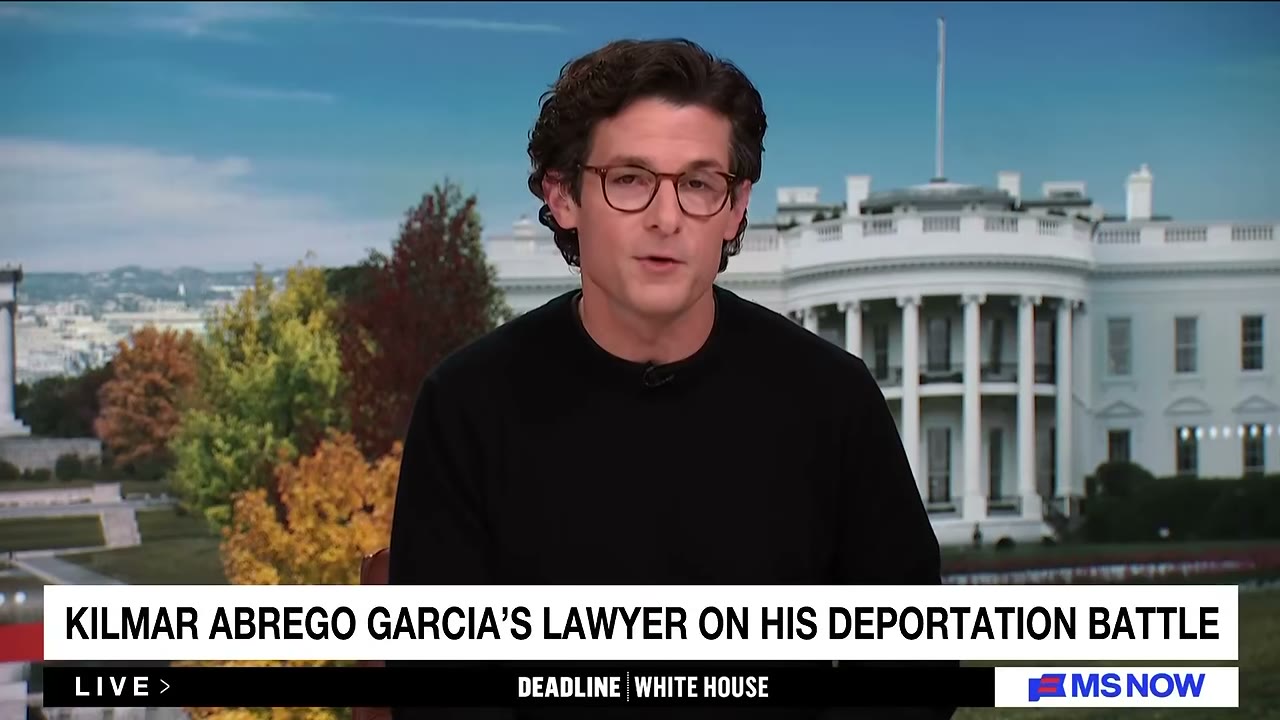
MS NOW examines the Kilmar Ábrego García case, the Maryland man mistakenly deported to El Salvador, and what it reveals about Stephen Miller's push against legal and undocumented immigration. Guests discuss mass deportation, third-country removals and the political symbolism of the case.
1Attorney Describes Ábrego García Family's Turn to Immigrant Rights Advocacy
Kilmar Ábrego García was snatched off a Maryland street at 29 — and now he and his wife have become defenders of immigrants' rights. His attorney, Simon Sandoval-Moshenberg, described the shift: Ábrego García was mistakenly deported to a notorious Salvadoran mega-prison by the Trump administration last year.
The attorney stressed he never asked for the role. "He is not someone who asked for this," Sandoval-Moshenberg said, contrasting him with activists who drew the administration's ire.
He said Ábrego García has grown into the mantle, and so has his wife Jennifer — both now described as defenders of due process and the rule of law.
2Panel Debates Whether Ábrego García's Release Is a Win for Rule of Law
Kilmar Ábrego García is now free — but only after self-deporting to Spain, which may become the first stop on a longer road before any possible return under a new Democratic administration.
A panel weighed whether that counts as a win for the rule of law. One guest called the case "such a strong example of how the war on immigrants is a war on constitutional rights."
The guest said immigrants have played a central role across history and that the outcome can be seen as a victory — but only one step. A second panelist agreed it is "the very beginning" of what will be a long journey for him.
3Why the Government Spent So Much Pursuing One Deportation Case
The government spent so much time and money pursuing Kilmar Ábrego García — and tried to send him to several African nations he had never been to and had nothing to do with.
Asked why, former acting ICE director John Sandweg said the case became "such a political symbol of this mass deportation effort."
It began with a mistake: Ábrego García never should have been sent back to El Salvador. But once he was there, Sandweg said, the administration engaged in a series of moves to save face.
4Former ICE Official Warns Third-Country Removals Happen at Larger Scale
Hundreds, if not thousands, of other cases are unfolding without the attention Kilmar Ábrego García received — and with less due process, a former ICE official warned.
John Sandweg called the case "one example of what's happening on a much larger scale." He said the administration has prioritized third-country removals, aggressively paying countries to take people back.
He said people are routinely sent to conditions where there are no guarantees they won't be returned to their home country, where they may face persecution. "It's very good in many ways that this case drew the attention it did," he said.
5Journalist Links Immigration Crackdown to Medicaid Cuts for Legal Immigrants
Hundreds of thousands of legal immigrants are being told they sit in the crosshairs — not for deportation, but for losing their Medicare coverage under a provision in Donald Trump's tax bill.
That's according to reporting from The Washington Post, cited by a panelist who said the administration is pursuing the tactic in what he described as a form of psychological warfare.
He said the effort targets immigrants "legal and undocumented in any way that they can," and noted the safe-third-country push has been pursued since the first Trump administration.
6Stephen Miller's Goal Described as Racial Re-Engineering and Punishment
Stephen Miller's aim has always been to strangle legal immigration, driven by a desire to racially re-engineer the country's demographics and punish immigrant communities, a journalist alleged.
The author of a book on Miller, Trump and the white nationalist agenda said the case is further evidence it was never about law and order or public safety.
He alleged the goal is using the war on immigrants to entrench economic inequality and erode constitutional rights. He pointed to Trump musing about sending U.S. citizens to foreign prisons, calling Ábrego García an experiment for doing this on a larger scale to political opponents.
7Ábrego García Case Compared to Family Separation as Policy Experiment
The Ábrego García case is being compared to family separation — described as a way the administration experimented with how far it could go.
A panelist said it should be understood the same way as the first-term separation policy, which he called almost a test of what the government could do. He and the host noted they have discussed it since 2018, at the height of the policy.
He recalled cases involving children as young as infants, with figures like Miss Rachel and New York Congressman Brad Lander attending hearings with them in person. He questioned whether there is a better way to hold such proceedings.
8Former ICE Director Says Crackdown Goes Far Beyond Worst of the Worst
The crackdown was sold as a focus on the "worst of the worst" — but it has gone far beyond that, a former acting ICE director said.
John Sandweg said enforcement now includes efforts to deport kids who came in as unaccompanied minors and grabbing individuals showing up for green card interviews while married to U.S. citizens.
He also cited attacks on legal migration: efforts to denaturalize long-time residents, scouring old green card applications for any basis to take a card away, and self-deportation pressure. He said it looks like two more years of this, and worried Congress will struggle to act given funding ICE already has.
9DHS Secretary Markwayne Mullin Posts Unproven Claims Against Ábrego García
Homeland Security Secretary Markwayne Mullin has been posting unproven allegations against Kilmar Ábrego García on social media — including that "this Salvadoran man will no longer terrorize innocent Americans."
A former law enforcement professional pushed back: if he's so dangerous, why not actually prosecute him?
John Sandweg said there was an effort to prosecute, a case he described as whipped together quickly to save face when Ábrego García was brought back from El Salvador. He called the prosecution politically motivated, and said Mullin appears to be feeling pressure.
10Mullin Pivots Rightward Under Criticism Over Deportation Commitment
Markwayne Mullin started out sounding bipartisan, even talking about the possibility of immigration reform. Then he pivoted rightward.
A panelist said there's a widespread perception Mullin isn't committed enough to the mass deportation effort, and that criticism from his right has driven changes in his messaging over the last three months.
The former ICE official called it a shame, saying this is a window when people at DHS who are tough on immigration agree the laws need reform — and that the pathway bouncing around Washington for 30 years is the proper one. He said the administration does not want to pursue it.
11Detentions of Princeton PhD Candidate and Valedictorian Questioned
A Princeton neuroscience PhD candidate was recently rounded up — and before that, a Maryland high school valedictorian.
A panelist cited both as examples of people swept up despite the administration's talk of the "worst of the worst." He called them useless detentions that do nothing to make American streets safer.
He said that's what Stephen Miller wants, now chief of staff to the president. The host urged the panel to keep looking at such examples.
12Journalist Urges Democrats to Defund ICE and Halt Deportations
Democrats must defund or abolish ICE, a journalist urged, calling the agency "Stephen Miller's private police force for worker subjugation and elite consolidation." The comment came as the guest weighed Miller's role over the next two years.
Whether Miller succeeds, the guest said, depends on how Democrats use their congressional majorities. They can't just investigate Miller — they must deliver for working families, which means meaningfully ending what the guest called the war on immigrants.
That war, the guest argued, is a war on labor: criminalizing a sector of the working class hands corporate elites a tool to suppress organizing and wages. The guest also called for a moratorium on detentions and deportations and a pathway to citizenship for the long-term undocumented.
13Miller's Santa Monica Upbringing Blamed on Liberal Hypocrisy
Stephen Miller grew up in Santa Monica watching state Democrats preach social justice while prioritizing corporate elites, a guest said — calling him "a product of liberal hypocrisy."
The remark came in a discussion of Miller's role, with the guest arguing that Democrats who helped create him now face the consequences. Miller, the guest said, perfected that rhetoric: gaslighting and hypocrisy, a language of working-class populism deployed while corporate interests came first.
The guest did not offer evidence for the claim about Miller's upbringing beyond the Santa Monica detail.