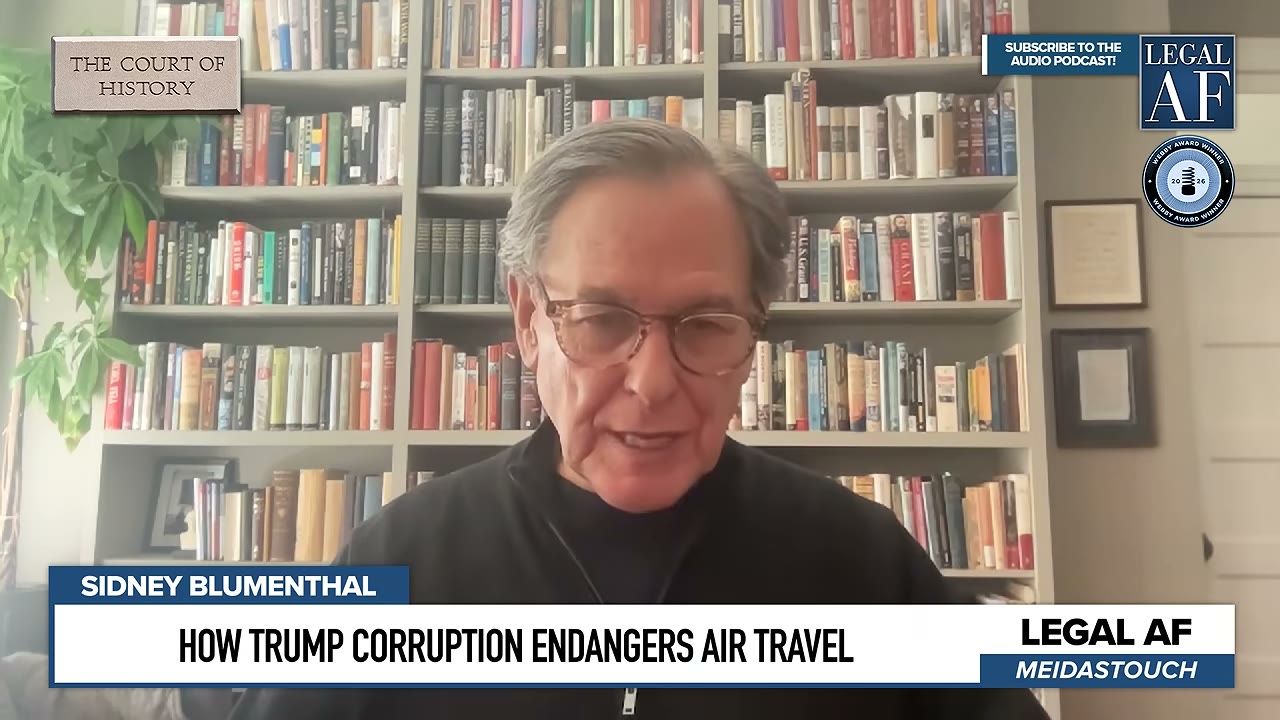
Legal AF's Court of History hosts Sidney Blumenthal and Sean Wilentz discuss aviation safety with journalist James Fallows. They examine Transportation Secretary Sean Duffy's conflicts of interest, an $875 million FAA contract awarded to a donor-linked startup, and the erosion of aviation safety culture under Trump.
1James Fallows joins Court of History to discuss aviation security and Trump-era undermining
James Fallows warned that America's aviation security system was deliberately dismantled — and his New York Times Magazine article landed just as planes were grounded. The former Carter speechwriter and Atlantic correspondent joined Court of History to discuss what he called the systematic undermining of safeguards by the Trump administration.
Fallows is an instrument-certified pilot who has studied the field in detail. He wrote 11 books, including "National Defense," which won the National Book Award. His Substack piece is titled "These are not serious people."
He traced how aviation security was carefully constructed over decades — and how it came under attack.
2Sean Duffy accused of prioritizing spectacle over running the FAA
Sean Duffy runs the Department of Transportation and the FAA — but critics say he treats the job as a stage. Fallows described him as a supporter of the "service for service" principle, more interested in spectacle and celebrity than in whether his organization actually works.
The criticism goes further: Duffy set up a reality show that, in Fallows' words, was "full of corruption underneath its shell."
The question now is whether that performative style has real consequences for aviation safety.
3Duffy's summer YouTube road trip funded by companies he regulates
Sean Duffy spent this summer on a six-part YouTube road trip with his family — sponsored by companies his own department regulates, most notably Boeing. The New York Times reported on it at the time, and critics raised conflict-of-interest questions.
Duffy said he didn't receive money directly from the companies, but they financed the entire project.
Before politics, Duffy was a professional logger and an MTV "Real World" star, where he met his future wife. His motto for the trip: "To love America, you have to see America."
4Duffy shows no growth in aviation knowledge and pushes video gamer hiring stunt
Months into the job, Sean Duffy's understanding of aviation had barely moved, critics say. His recent comments were almost identical to what he said when he first took office — platitudes about Trump fixing everything quickly.
Past transportation secretaries like Pete Buttigieg and Elaine Chao also arrived without aviation expertise, but they studied. Duffy, critics say, performed instead.
His answer to a chronic air traffic controller shortage dating back to the Reagan era: a program to hire video gamers, presented with AI clips comparing the job to a shooting game.
5Fired inspectors general leave GAO as main oversight tool for aviation contracts
Democrats have asked the Government Accountability Office to investigate aviation modernization contracts awarded in the past year and a half — money that flowed mainly after the "big beautiful bill."
The request follows a GAO study from just two months before last week's failure. It warned that the rush and lack of focus in the FAA's modernization effort increased the risk of exactly this kind of breakdown.
Trump fired inspectors general in his first days in office, leaving the GAO as the main oversight tool. Historians called the GAO study prescient.
6Startup Aerospace Intelligence with no ATC experience wins FAA contract
A startup with no experience in air traffic control won a major FAA modernization contract — backed by Andreessen Horowitz. The firm, Aerospace Intelligence, is based in Boston and develops aviation software.
The work is part of the Trump-Duffy program to modernize air traffic systems, including rewiring from copper to fiber optic cables and an AI-based program meant to improve weather forecasting and routing.
Marc Andreessen went from founding Netscape to being a major right-wing donor. His partner Ben Horowitz is a descendant of David Horowitz.
7Duffy's son-in-law Michael Alfonso won Wisconsin House race with contractor money
Michael Alfonso, Sean Duffy's 26-year-old son-in-law, won Wisconsin's 7th congressional district — a Republican stronghold — even during a "blue wave." He received incredible amounts of money from federal contractors regulated by the Department of Transportation, which his father-in-law runs.
Alfonso was also on the family road trip, at least for parts of it.
Fallows compared the arrangement to Teapot Dome, calling it a "pay-to-attend" system: direct cash payments financed both the trip and the campaign, from organizations Duffy regulates or contracts with.
8Aerospace Intelligence got $875 million FAA contract after PAC gave to Alfonso
Aerospace Intelligence's PAC donated to Michael Alfonso's campaign in March 2026. On June 22, Sean Duffy announced the FAA had awarded the company an $875 million contract to build the technology foundation for its air traffic control command center.
Democrats in Congress have already asked the GAO to investigate. Next year, a Democratic majority will have authority to probe the contract directly.
It is highly unusual for a startup to win a contract of this magnitude for something touching the fundamentals of aviation safety — and more unusual still that it donated to the cabinet secretary's son-in-law.
9Halmar International executive donated to Alfonso before winning Penn Station bid
An executive vice president of Halmar International donated to Michael Alfonso's campaign in March. On May 20, Sean Duffy announced Halmar had been selected as master developer for the Penn Station renovation in New York.
The Department of Transportation oversees not just air travel but rail, roads and everything else.
The pattern repeats: money to the son-in-law's campaign, followed weeks later by a major contract from the secretary's department.
10Historians call Trump administration a kleptocracy, not ordinary corruption
Historians on the panel argued that "corruption" is the wrong word — because it presumes a normal government that has decayed. This government, they said, is corruption itself.
They called it a kleptocracy: a regime where "fees for services" are built into how the system works. There has never been a president who was himself corrupt and set an example followed at every level, they said.
There were corrupt officials before, and scandals like Credit Mobilier. But not a system where pay-for-service is fundamental.
11Musk's push to replace Verizon with Starlink raised air traffic control risks
Elon Musk spent his first month or two in the administration attacking Verizon, which held a contract to upgrade air traffic control communications equipment. He called the technology outdated and pushed Starlink instead.
That could have dangerous consequences, Fallows said: Starlink, despite its strengths, is not yet as reliable as air traffic control systems require.
Quickly replacing tested systems without the proper aviation testing was held back by resistance inside the system. The danger of ill-conceived changes remains.
12Aviation insiders fear speaking on record due to administration vindictiveness
NTSB chair Jennifer Homendy testified that during the Potomac plane crash investigation, people were afraid to talk to investigators — the first time in her experience. Fallows interviewed over 100 people for his article, but only two or three are quoted by name.
He cited a near-catastrophic Blue Angels flight over Pensacola this year, when 100 people on the ground were seconds from dying. The unit's commander took responsibility immediately.
Defense Secretary Hegseth, Fallows said, seemed to brag about the "macho" prank. The insidious danger: people now fear the organizations they work for.
13NTSB posts statement disputing Fallows article after publication
The National Transportation Safety Board published a statement disputing a New York Times article — after the piece ran — saying it left out the agency's numerous statements backing Sean Duffy and President Trump.
The article's author says he quoted NTSB chairwoman Jennifer Homendy several times, including her warnings about signals being ignored.
Asked about the fallout, the author points to two risks: in the short term, things being replaced for bribery reasons; in the long term, an erosion of culture from the perception that corrupt people are at its helm. Some kind of investigation will follow, he says.
14Fallows urges Democrats to hold flight safety hearings under oath
Democrats should make flight safety a personal mission and convene a series of hearings where witnesses testify under oath, the adviser says.
He points to the mid-1960s, when lawmakers took up car and cigarette safety after Ralph Nader's book "Dangerous at Any Speed," and to the old Proxmire hearings as a model.
A lawmaker from any district should convince people that air travel and flight safety are fundamentally important to the country's economic well-being, the safety of its people and international competition, he says.
Hearings should dig into what happened during the work stoppage, the Potomac incident and the rise in dangerous encounters — which fell under the Biden administration after a serious 2023 incident and have grown significantly over the last two years, he says.
"I would like to see hearings, particularly a series of hearings on flight safety, inviting people to testify under oath about what happened and what should be done," he says.
15Fallows says air travel remains safest despite mounting warning signs
Air travel is still the safest way to spend time and remains phenomenally safe, the adviser says — even as he warns that something is going to go wrong.
People in the system lean toward safety and slowing things down, he says, but lines of tension are emerging and something has to be done about them.
His warning comes as he says everyone has held their breath boarding a plane under Trump's rule, arguing that everything Trump touches becomes less safe.