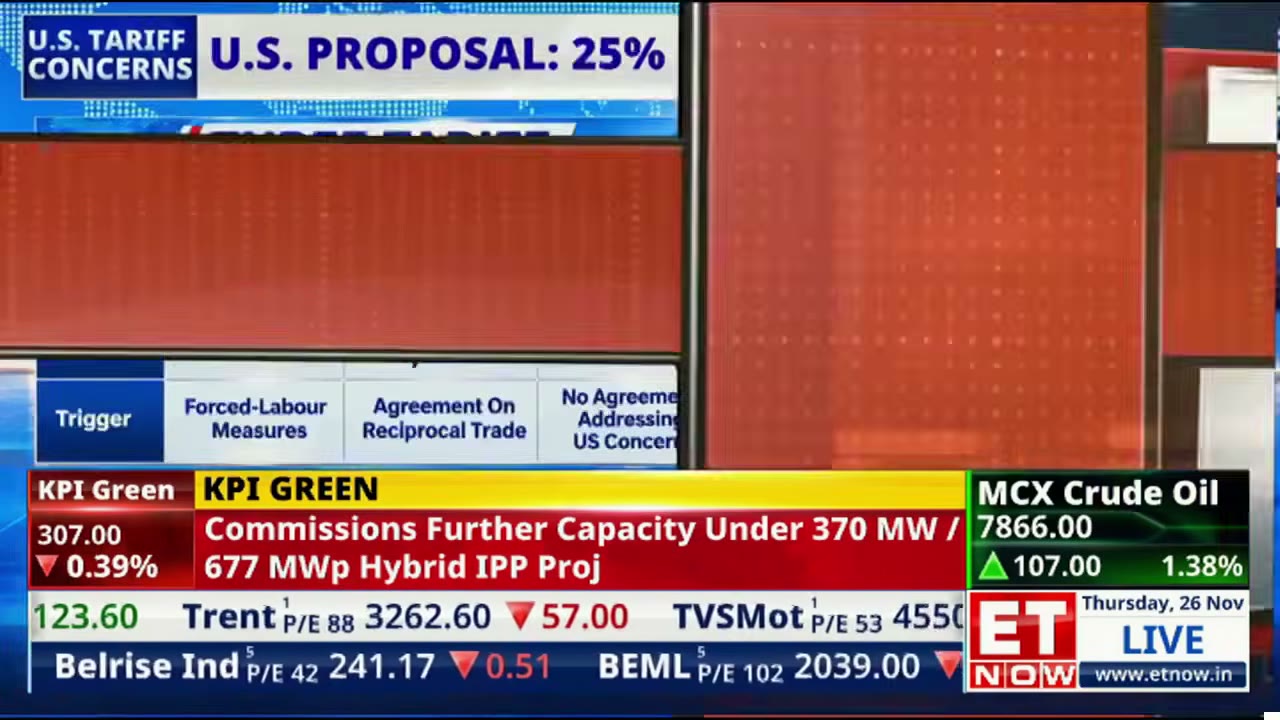
The US has proposed a 25% tariff on India, reducible to 17% if a trade deal is signed, following a Section 301 overcapacity investigation. India rejects the allegations and insists issues be resolved through bilateral talks, while exporters warn of pressure tactics.
1US proposes 25% tariff on India, 17% with trade deal
India faces a proposed 25% US tariff — the second-highest among its competitors — unless it signs a trade deal, which would bring the rate down to 17%. The Trump administration proposed the tariffs on India and 13 other economies, following a Section 301 investigation in which the US pointed to excess production capacity in several sectors.
India has protested. New Delhi dismissed US concerns about overcapacity, saying any trade issues should be resolved through bilateral negotiations.
Exporters are pushing back too. GTRI called the US move a calculated trap to demonstrate an advantage in ongoing trade deal negotiations.
That leaves the question hanging over the talks: is the tariff threat a pressure tool, and what will it mean for exporters?
2USTR report targets India's PLI schemes and overcapacity
Washington's case against India rests on a claim that India's industrial policy is creating excess capacity — and it says American manufacturers are paying the price. A USTR report argues that India's plans to expand domestic production, such as PLI schemes, create overcapacity, and that India's alleged inability to solve the problem of global overcapacity affects US interests.
The report says this harms the ability of American manufacturers to compete in international markets and contributes to reduced production in the United States.
The proposed 25% tariff stems from what the US calls structural problems and overcapacity. The US has offered to cap tariffs on India at 17% if a trade deal is reached.
These proposals are subject to rebuttals and overcapacity hearings, which begin on January 25, 2027. India's exports already face MFN tariffs of over 10%.
3Commerce Ministry denies structural overcapacity in any sector
India says it has no structural overcapacity in any sector — a direct rejection of the US case behind the proposed tariffs. In a detailed note, the Commerce Ministry said trade issues should be addressed within the framework of ongoing negotiations on a bilateral trade agreement, and that the government remains committed to working closely with the United States to conclude the agreement quickly.
The push comes as the two countries negotiate a deal. Pharmaceuticals, energy, some electronics and auto parts remain outside the current framework — goods that account for about 45% of India's exports to the United States.
Much now depends on the hearings scheduled for January.
4Experts debate whether 17% tariff gives India competitive edge
Even a 17% tariff may not be the win it looks like, one analyst warned, because the deal's fine print is still unseen. Professor Arpita Mukherjee of ICRIER said the choice is between 25% without a trade agreement and 17% with one, but "on US terms."
If the agreement does not guarantee a maximum tariff level, the US could raise rates again soon, she said, adding that countries that already have trade deals face the same uncertainty.
She suggested India keep negotiating — from 18% down to 17%, and possibly on to 15%. "The US has already shown flexibility on this issue," she said.
Her other point: India must prove with scientific justification that the PLI scheme was mostly used for the domestic market, not exports.
5EEPC chairman calls US overcapacity argument dishonest
A top engineering exporter dismissed Washington's overcapacity case outright, saying the Commerce Ministry has already reported in a detailed memo that no excess capacity exists. Pankaj Chadha, chairman of EEPC, said the US is simply negotiating the way it always does — from a position of strength, starting the game on one side and then giving something up to look like it did a good job.
"I can only say that this is a dishonest argument," he said, calling the negotiations unfair.
Still, he said India has no choice but to negotiate and see what it can get.
6Textile, leather, handicraft sectors most at risk from 25% tariff
Textiles would be the biggest victim if the 25% tariff takes effect, followed by leather and handicrafts, according to EEPC chairman Pankaj Chadha. Engineering would also feel it — though he noted engineering already faces a 232 tariff of 50%, and as far as he knows that tariff is not added to the 232.
He said clarity is still missing on whether the 301 tariffs would be added to the existing 10% 301 tariff on forced labor, and whether they would stack onto the 232 tariff of 50%.
India's stated position is that it needs to be significantly more competitive than rivals such as Malaysia and Bangladesh in textiles, and Indonesia. If competitors get 18% and India gets 17% after heavy concessions, he said, India must decide consciously whether that is worth it.
7PLI subsidies could invite countervailing duties under WTO rules
India's PLI scheme carries a legal risk it cannot negotiate away: product-specific subsidies are not allowed under the WTO agreement on subsidies and countervailing measures. Professor Arpita Mukherjee of ICRIER said it is therefore logical that anyone can impose a countervailing duty on PLI if India exports a lot of products made using it.
She said India carried this risk when it changed its previous subsidy regimes and began providing specific subsidies for products.
The US has the right to impose countervailing duties if it can prove excess capacity exists in these product areas, she said — but it must collect data on the surplus. She also said the US has made the WTO "a little incompetent," with the dispute settlement mechanism not working.
8India needs data to prove exports did not surge into US
The tariff fight will come down to data. Professor Arpita Mukherjee said the US must collect data on surplus capacity, and India must collect data to prove no excess capacity exists — and, even if it does, that it is not exported to the United States.
India also needs to show there has been no massive increase in exports to the US over the last three or four years, she said.
But she argued the bigger issue is how the tariffs are planned to be applied overall — product by product — and that failing to reach a deal leaves the uncertainty in place. Temporary relief may come, she said, but the uncertainty remains.
She said India must monitor what others get and how sectoral and cross-sectoral tariffs interact.
9Experts warn changing US rules make deal unpredictable
The US has changed its position on many things in recent months, including these tariffs, and that is making a deal hard to pin down. Asked whether a deal is needed more by the US or India, EEPC chairman Pankaj Chadha refused to pick sides, saying a deal should benefit both parties.
He said India will negotiate but must agree on terms acceptable to its domestic consumers and economy. "I can't say that this is a very pleasant situation," he said.
Professor Arpita Mukherjee raised the core problem: whether this is the end of the deal or a dynamic situation where new positions emerge day after day.
10Section 301 hearings in January to shape final tariff decision
The final call on the Section 301 tariffs will come after hearings in January, and India has made clear it wants the concerns handled only inside the bilateral trade negotiations. Professor Arpita Mukherjee said that once the hearings end, Washington will make what it calls a final decision under Section 301.
Negotiations will continue in the meantime, but she drew a line: "I cannot negotiate, as I said, at gunpoint." She said talks should be calm, thoughtful and real — not just concessions.
She said India's team is professional and extremely competent, but the question is whether it makes sense to just make a deal or to take time and analyze it from the perspective of the Indian economy.
11Expert suggests 12-15% tariff and compensation mechanism
A 17% tariff would not give India a real edge over competitors at 18%, according to Professor Arpita Mukherjee of ICRIER, because India's costs — such as logistics — are often much higher than rivals'. She suggested India push for about 12-15%, calling 15% the minimum needed for a strong competitive advantage.
If the US cuts the rate from 17% to 15%, she said, it should be anchored with reliable compensation mechanisms so India is compensated if tariffs change again. Otherwise, she warned, the problem will recur.
She also flagged other barriers, including forced labor, and said audits, social checks and fair trade standards are partly the responsibility of American companies buying in other countries.
12India seeks lasting competitive advantage and stable policy
A 1% tariff advantage is not a competitive advantage in any trade deal, EEPC chairman Pankaj Chadha said, warning that India needs a significant and lasting edge before it signs. "We have a lot to offer in this deal," he said, adding that if the only offer is a 1% advantage, he doesn't think India should even respond.
He said India needs two guarantees: a solid competitive advantage that lasts a long time, not one that disappears in three months when Washington springs another surprise, and a stable political situation rather than constantly changing rules.
He rejected the idea of a dynamic deal that keeps India hustling to catch up with unexpected changes.
13Experts doubt deal will meet January 2027 deadline
Asked whether the trade agreement can be concluded by the January 20, 2027 deadline — after an earlier July deadline slipped — EEPC chairman Pankaj Chadha said only political leaders can answer that. He declined to give a prediction.
Professor Arpita Mukherjee said negotiations are good when they get done, and that the longer a fight over war or geostrategy drags on, the more exhausting it becomes for the opposition. She called the US a big market India cannot ignore and urged patience: ask questions calmly, pull as much as possible, and see the matter through.
The talks continue with no confirmed end date.
14Government convenes fresh Parliament session from November 30
Parliament is coming back for a session that could be over almost as soon as it starts. Parliamentary Affairs Minister Kiran Rijiju said the government has written to the Lok Sabha Speaker and Rajya Sabha Chairman asking them to convene both houses.
The Lok Sabha is summoned to resume on Monday, November 30. The Rajya Sabha follows on Wednesday, December 2.
Rijiju added that, depending on the needs of parliamentary work, the sessions of both houses could end as early as December 3.
The government says it wants to consider important government matters and complete key legislative business.
15Pablo Hernández de Cos set to lead European Central Bank
Spanish economist Pablo Hernández de Cos is set to become the next president of the European Central Bank, after securing the support of most eurozone governments. He is expected to replace Christine Lagarde in February 2027.
The Netherlands withdrew its support for former central bank governor Klaas Knot and joined the consensus around de Cos, the former Governor of the Bank of Spain and now General Manager of the Bank for International Settlements.
He takes over at a difficult time: inflation has risen to 4%, well above the ECB's 2% target, while rising government borrowing costs and concerns about public debt remain key challenges.
Official approval from European institutions and leaders is still awaited.
16Mumbai Police goes digital with AI system and smart cards
Mumbai Police is going digital, and Chief Minister Devendra Fadnavis handed over the tools to make it happen. At an event at the Sahyadri Guest House, attended by ministers Mangal Prabhat Lodha and Ashish Shelar, he said modern technology will ensure fairness, speed, transparency and accountability in police work.
Fadnavis launched a new anti-drug investigation van under the campaign 'Drug-Free India, Drug-Free Maharashtra'. He also announced that an AI-based system called 'Tapas Sarathi' is being developed to move the entire chain from FIR filing to charge sheet and evidence management onto a digital platform.
The Digi ID smart card is the new official identity card of the Mumbai Police. The Mumbai Police Integrated System brings the force's diverse tasks into one digital system, and a citizen mobile app lets people use police services digitally.