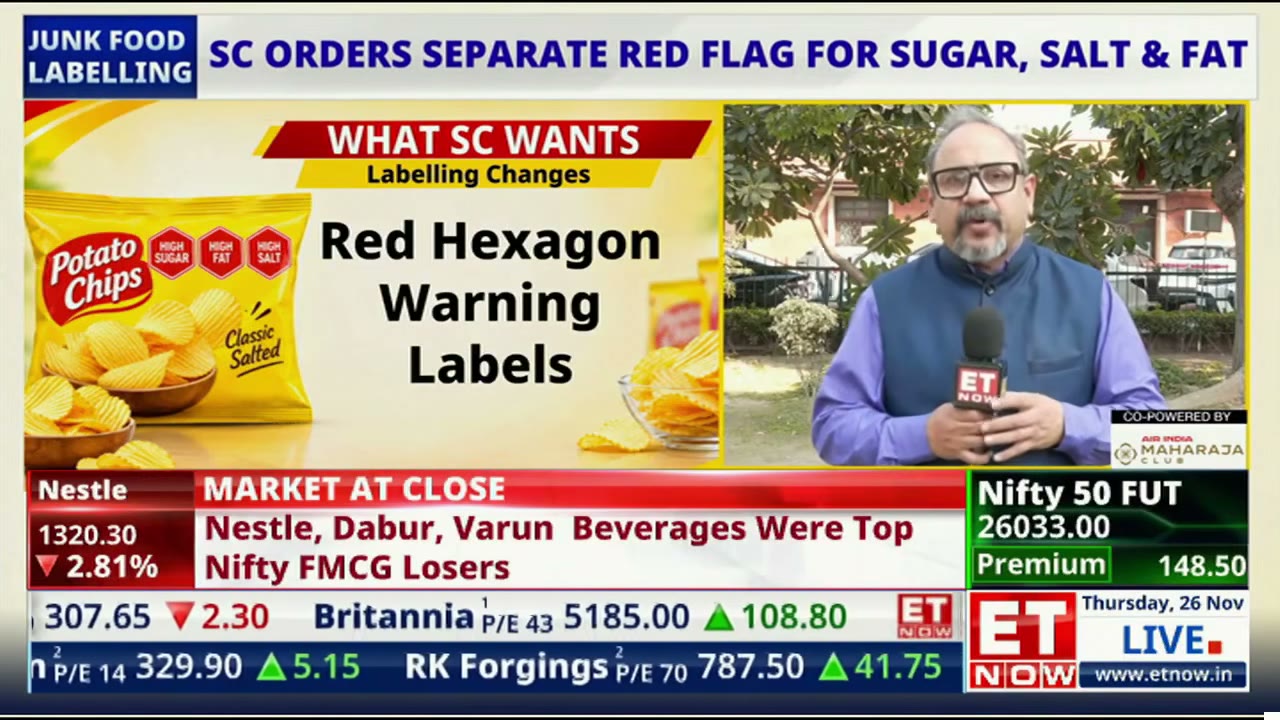
The Supreme Court has directed the Centre and FSSAI to introduce front-of-pack nutrition labelling in a single phase for foods high in salt, sugar and saturated fat. The ruling affects India's Rs 11.17 lakh crore food and beverage industry and could force FMCG firms to reformulate products.
1Supreme Court Directs Single-Phase Front-of-Pack Nutrition Warnings
The Supreme Court wants front-of-pack nutrition warnings on all packaged foods high in salt, sugar and saturated fat — in one phase, not two. The court said it is deeply concerned about citizens' health, especially growing children, and that people have the right to know what they are consuming.
The Centre and FSSAI had planned a phased rollout. In the first phase, only products with more than two harmful components would get a red hexagonal label; the second phase would cover packages with at least one harmful nutrient. The court rejected the delay: "let it be implemented in one phase."
It went further. A hexagon alone is not enough — the label must graphically show which harmful substance is inside, whether fat, salt or sugar. The court also said the topic should enter school and college curricula so students learn what they are consuming.
The directives are sweeping, but FSSAI still has to work out the details within the court's framework.
2Former FSSAI Chief Says 10-Year Labeling Logjam Finally Broken
India has debated front-of-pack nutrition labels for a decade — and only the Supreme Court has now broken the deadlock, former FSSAI chief Pawan Agarwal said. Talks began in 2016, when he had just taken over the food regulator.
Years of consultation with business and consumer groups failed to settle the final form of the warnings. The country wavered between star ratings on the front and warning labels, Agarwal said, and only the court's intervention moved things "point by point" — how warnings should look, where thresholds sit, and which nutrients count as "problem" ones.
"Now there is light at the end of the tunnel," he said, adding that what was postponed for 10 years will soon become a reality. FSSAI still has to work out further details within the court's framework.
3Agarwal Says Red Hexagon Warnings Work Without Reading Language
You don't need to read a word to know a product is unhealthy — one, two or three red hexagons on the pack tell you, Pawan Agarwal said. The former FSSAI chief said the labels are simple enough that even buyers who cannot read the language can spot a problem product.
He flagged a gap: much salt, sugar and fat is consumed outside packaged foods, and this intervention doesn't address that. The Supreme Court also ordered education on labels and warnings in schools, and said long-standing rules on what can be sold in schools must finally be enforced.
Agarwal said the labels could also let retailers regulate how unhealthy foods are presented — opening healthier options for consumers.
4Threshold Debate: 93-94% of Packaged Foods Would Carry Warnings
Thresholds discussed in the Supreme Court were so low that 93–94% of prepackaged products would carry warnings — making the labels meaningless, Pawan Agarwal said. The former FSSAI chief said much of the decade-long delay came down to where those threshold values should sit.
The court noted they should be neither too low nor too high, leaving room for consumers to choose while allowing levels to be lowered gradually. Agarwal's Food Future Foundation filed a motion to intervene and gave the court data on how different thresholds change the number of products carrying warnings.
His ideal: about a third of products with warnings, then lower thresholds over time. He called it a long transition from what companies produce now to a healthier packaged food sector.
5FMCG Firms Expected to Reformulate Products to Avoid Warning Labels
If FMCG brands want the warnings gone, they will have to change their recipes — not just their packaging, Pawan Agarwal said. Products that exceed the set thresholds will force companies to review ingredients, the former FSSAI chief said.
He described the old packaged food market as a race for share through ever more addictive products — more salt, sugar and fat. The thresholds, he hopes, will push in the opposite direction.
But he warned of a trick seen in Latin America: when warning labels appeared, manufacturers kept selling the old products and launched a pricier warning-free line. Consumers didn't switch, and nothing changed. He said the sector needs monitoring and incentives for companies to change composition over time.
6Expert Hopes Regulation Reshapes India's Food Production and Labelling
Any regulation that raises awareness helps — whether it is a graphic image, large print or something else — as long as the goal is healthier nutrition and dietary habits, Pawan Agarwal said. He hopes the Supreme Court's push will change the way India produces, packages and labels food.