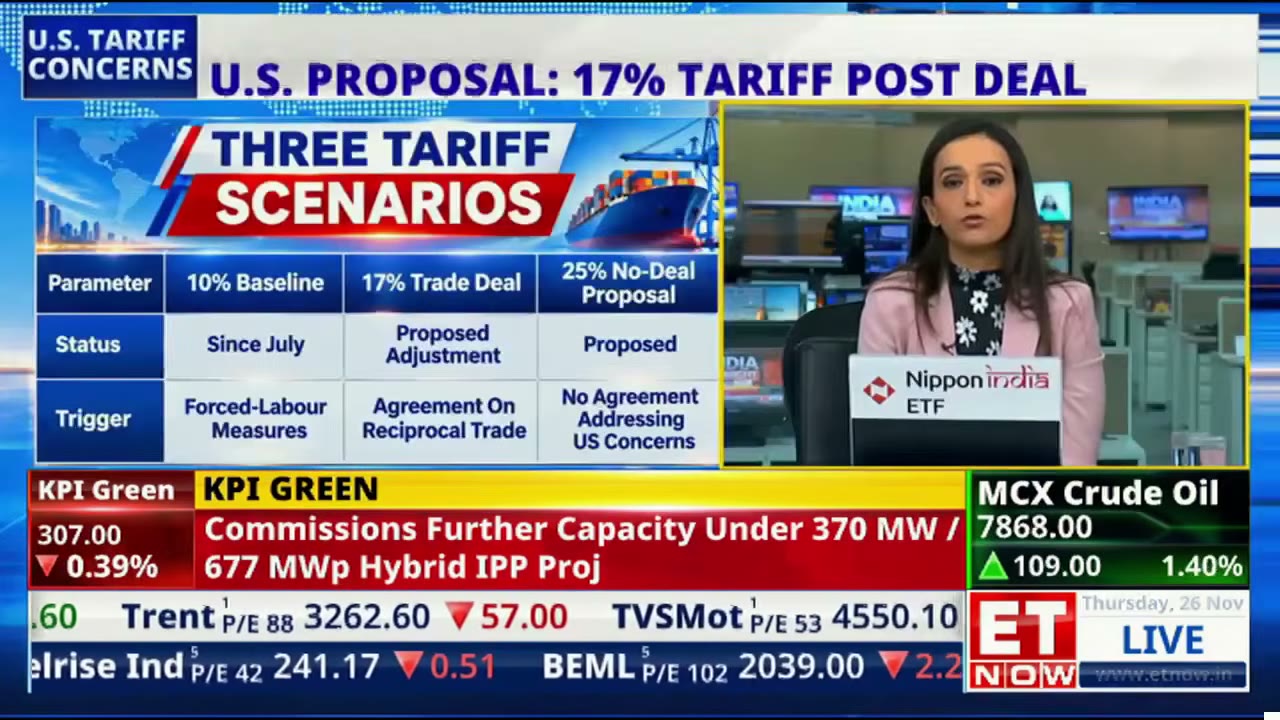
The US has proposed a 25% tariff on India, reducible to 17% if a trade deal is signed, citing a Section 301 probe into structural overcapacity. India denies excess capacity and insists concerns be settled in bilateral talks, as exporters warn of damage to textiles and leather.
1US Proposes 25% Tariff on India, 17% With Trade Deal
India faces a proposed 25% US tariff — the second highest among its competitors — unless it signs a trade deal. The Trump administration unveiled the plan for India and 13 other economies after a Section 301 investigation flagged structural overcapacity in several sectors.
A deal would cut the duty to 17%, according to the updated tariff structure. Without one, India stays at 25%.
The proposal is tied directly to the investigation's findings, which the US used to justify the higher rate. India has opposed that reasoning.
What comes next depends on the Section 301 process, with hearings scheduled for January.
2India Rejects US Overcapacity Claims, GTRI Calls Move a Negotiating Ploy
India has dismissed US concerns about overcapacity, saying trade issues should be resolved within the framework of ongoing bilateral negotiations. The response came after Washington proposed a 25% tariff on Indian goods, cut to 17% if a deal is reached.
Exporters are pushing back too. GTRI called the US move a calculated ploy to show its advantage in the ongoing trade deal negotiations.
The two sides remain in talks, with the tariff proposal hanging over them.
3USTR Report Targets India's PLI Schemes Over Excess Capacity
The US trade representative has proposed a 25% tariff on India over structural problems and excess capacity — and offered to cap it at 17% if a trade deal is reached. The proposals are subject to rebuttal, with hearings on excess capacity set to begin on January 25, 2027.
Indian exports currently face MFN tariffs of over 10%.
The USTR report says India's industrial policy and plans to expand domestic production, like the PLI schemes, are creating excess capacity. It claims this harms American manufacturers' ability to compete internationally, contributes to reduced production in the US and has cost American manufacturers export opportunities.
4Commerce Ministry Denies Structural Overcapacity in Any Sector
India does not have structural overcapacity in any sector, the Ministry of Commerce said in a detailed note, rejecting the US case behind a proposed 25% tariff.
The ministry said trade-related issues should be addressed within the framework of ongoing negotiations on a bilateral trade agreement, and that the government remains committed to working closely with the US to conclude one quickly.
The talks matter beyond the headline rate. Pharmaceuticals, energy products, and some electronics and auto parts sit outside the current framework — about 45% of India's exports to the US.
The final decision will largely depend on hearings scheduled for January.
5Expert Panel Debates Whether Tariff Threat Is a Bargaining Chip
Two experts weighed whether the US tariff threat is a bargaining chip or coercion, as India and Washington negotiate a trade deal.
Professor Arpita Mukherjee of ICRIER said nothing can be judged until the trade deal documentation is seen. "If the trade agreement does not include a cap on tariffs, they may increase them in the near future," she said.
She noted that countries with trade agreements face a similar situation, and that the US has already shown flexibility on tariffs. India's goal, she said, is to keep negotiating rates down — from 18 to 17, then toward 15 — and to prove with data that the PLI program mainly served domestic consumption, not exports.
6EEPC Chairman Says US Overcapacity Argument Is Dishonest Tactic
The US argument that India has excess capacity is not correct, EEPC Chairman Pankaj Chadha said, backing the Commerce Ministry's detailed memo denying it.
"This is just a negotiation tactic," he said, describing the US approach as negotiating from a position of strength and then giving some away to seem like a good job. He called it a dishonest argument and unfair negotiations — but said India must negotiate anyway.
"We have no other choice," Chadha said.
He did not dispute the stakes: without a deal, India faces a 25% tariff.
7Textiles and Leather Face Biggest Losses From 25% Tariff
Textiles would take the biggest hit if the 25% tariff is implemented, followed by leather and handmade products, EEPC Chairman Pankaj Chadha said.
Mechanical engineering would suffer to some extent too, though it already carries a 232 tariff of 50%, which he said is not added to the 25%.
Key clarity is still missing: whether the Section 301 tariffs will be added to the existing 301 tariff of 10% on forced labor, and whether they stack on the 232 tariff of 50%.
Chadha said India's stated position is to be significantly more competitive than rivals such as Malaysia, Bangladesh in textiles, and Indonesia. With a deal at 17% against rivals at 18%, he said, that edge is thin — and the decision on whether to accept it must be conscious.
8Professor Warns PLI Subsidies Expose India to Countervailing Duties
India's PLI scheme is a specific subsidy, and under the WTO agreement on subsidies and countervailing measures, specific subsidies on products cannot be provided, Professor Arpita Mukherjee said.
That means countervailing duties are legally possible if India exports large amounts of PLI-produced goods. "We always carried this risk when we changed our previous subsidy regimes," she said.
With the WTO's dispute settlement mechanism not working, the US can impose such duties if it proves excess capacity — a finding India can challenge with data, including showing no massive jump in exports to the US in the last three or four years.
She warned the uncertainty persists without a trade deal.
9Panel Asks Who Needs the India-US Deal More
As the US shifts its position on tariffs, the panel was asked who needs the India-US agreement more.
EEPC Chairman Pankaj Chadha refused to pick a side, saying the deal benefits both parties. But he said India must reach an agreement acceptable to its domestic audience.
"I can't say that this is a very pleasant situation," he said, adding that India should calculate everything before making a deal and keep negotiating for a compromise that gives some competitive advantage.
The bigger worry raised: goals are shifting and everything keeps changing, making it hard to know how to deal with the situation.
10Section 301 Hearing in January to Decide Final Tariff Outcome
A Section 301 hearing in January will produce what officials call a final decision, EEPC Chairman Pankaj Chadha said, as India and the US negotiate a trade deal under the shadow of a proposed 25% tariff.
India has made clear that concerns related to the Section 301 investigation should be addressed solely within the framework of the ongoing bilateral trade negotiations.
Chadha said negotiations will continue through the process — but on his terms. "I cannot negotiate, as I said, at gunpoint," he said, calling for calm, thoughtful talks that are real negotiations, not just concessions.
He said India's team is professional and competent, and that any deal must make sense for the Indian economy.
11Expert Seeks 12-15% Tariff With Compensation Guarantee for India
Settling at 17% while competitors get 18% would not give India a significant competitive advantage, Professor Arpita Mukherjee said, because costs such as logistics are often higher in India.
She suggested India push for 12-15%, with 15% the minimum needed for a strong edge — and secure that rate with solid compensation if tariffs change.
She also flagged other potential trade barriers, including forced labor, which can turn into a trade dispute. Inspections, social audits and fair trade principles must be implemented, she said, and due diligence in supply chains is partly the responsibility of American buyers.
12Chadha Demands Lasting Competitive Advantage and Policy Stability
A 1% tariff advantage is no advantage at all, an industry chairman said, as India weighs a US trade deal while its exports keep facing a 17% tariff.
He said New Delhi's official position is clear: any deal must deliver a real edge. "We need a significant competitive advantage that will last for a long time," he said, warning that a thin margin could be undone by another "surprise" in three months.
India also wants policy stability, not an agreement that keeps shifting and forces constant adjustment. He said both guarantees are needed before India signs.
13Panel Doubts Deal Will Meet January 27 Deadline
The trade deal's deadline has already slipped once, from July to January 27, and one panelist would not predict it will be met. "Only political leaders can answer this question," he said.
He argued drawn-out negotiations favor neither side and urged calm. "We have to be very, very patient," he said, calling the US a big market India cannot ignore.
Another panelist said the deal must land at a price, or with a competitive advantage, that makes India's effort worthwhile and puts it in a leadership position.